Best Docparser Alternative for Document Parsing (2026)
Compare Docparser vs PDFSub for document parsing. See Zonal OCR limits and better AI options.
PDFSub is best for:
- Users tired of creating a new template for every document layout - PDFSub's AI adapts automatically
- Small teams needing extraction at $20/user/mo (annual) instead of Docparser's $39-159/mo credit tiers
- Bank statement processing with 20,000+ pre-built templates that auto-detect formats
- Non-technical users who want browser-based extraction without configuring parsing rules
PDFSub is NOT best for:
- Teams needing Zapier/Make automation triggers when new documents arrive
- Organizations with highly consistent document layouts where template-based zonal OCR works perfectly
- Workflows requiring parsed data to auto-route to Google Sheets or CRMs without manual export
Docparser is a cloud-based document parsing platform that uses Zonal OCR and template-based extraction rules to pull structured data from PDFs, Word documents, and images. The platform features a drag-and-drop rule builder where you click on the data you want to extract, and Docparser creates parsing rules for that zone of the document. It exports parsed data to CSV, Excel, JSON, and XML, and integrates with Zapier, Google Sheets, and other automation tools. For businesses that process consistent, predictable document layouts at moderate volume, Docparser provides a straightforward extraction workflow.
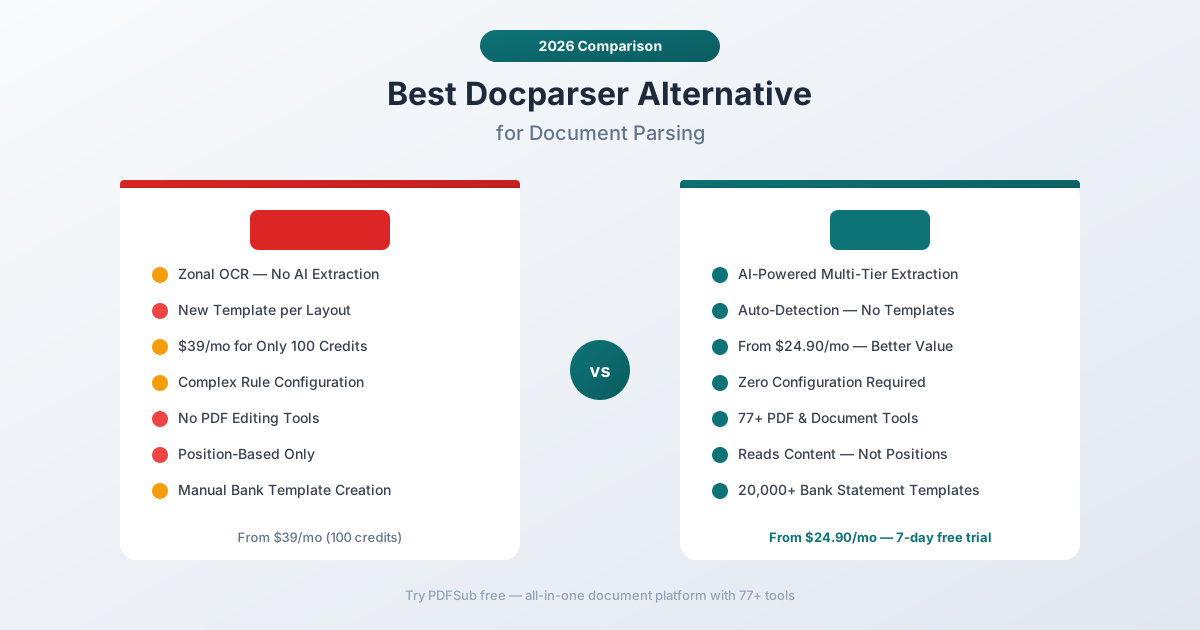
But Docparser has fundamental limitations. Its Zonal OCR approach requires a new template (called a "parser") for every distinct document layout. It lacks AI and GPT-powered parsing, making it inflexible when document formats vary. Several users find creating custom parsing rules time-consuming for complex documents. And pricing starts at $39/month for just 100 parsing credits, scaling to $159/month for what is still a modest processing volume.
If you've been evaluating Docparser but find the per-layout template requirement, lack of AI extraction, or credit-based pricing mismatched with your needs, this guide compares alternatives and shows where you get the best value.
Why People Look for Docparser Alternatives
Docparser earns praise for its intuitive drag-and-drop rule builder and reliable extraction for consistent document formats. The complaints center on template rigidity, lack of AI capabilities, complex rule creation for advanced documents, and pricing that feels steep for the volume provided.
One Template Per Layout
Docparser's Zonal OCR extracts text from specific zones (positions) on a document page. This means every document layout requires its own parser template:
- Different bank? New parser.
- Same bank but updated statement format? Modify or create a new parser.
- New vendor invoice layout? New parser.
- International document with different field positions? New parser.
For businesses that receive documents from dozens of banks, hundreds of vendors, or across multiple countries, the template proliferation becomes a significant maintenance burden. Each format change requires manual parser updates.
PDFSub uses a multi-tier extraction approach that doesn't depend on fixed zones. Tier 1 (browser-based) uses pattern matching and column detection that adapts to layout variations. Tiers 3-4 use AI that reads documents semantically - understanding what fields mean, not just where they're positioned. For bank statements, 20,000+ pre-built templates auto-detect formats without manual parser creation.
No AI or GPT-Powered Extraction
Docparser relies on Zonal OCR and rule-based parsing. It doesn't use AI, machine learning, or large language models for extraction. This means:
- It can't handle unfamiliar document layouts without a pre-configured template
- It can't interpret context or meaning - only position-based extraction
- Complex tables with varying column counts or merged cells challenge the rule system
- Documents with non-standard layouts require extensive rule configuration
PDFSub's Tier 3-4 extraction uses Gemini AI to read documents like a human - understanding headers, recognizing table structures, and extracting data based on meaning rather than fixed coordinates. This handles layout variations that Zonal OCR cannot.
Complex Rule Creation
While Docparser's drag-and-drop interface is intuitive for simple fields, reviewers note that creating parsing rules for complex documents is challenging and time-consuming. Multi-line table extraction, conditional fields, and documents with variable-length sections require extensive rule configuration.
PDFSub's extraction is largely automatic. For bank statements, upload the document to the bank statement converter and auto-detection handles the rest. For invoices and receipts, AI reads the document structure without manual rule configuration.
Pricing Feels Steep for Volume
Docparser's plans:
- Starter: $39/month for 100 parsing credits
- Professional: $74/month for 250 parsing credits
- Business: $159/month for higher volume
At $39/month for 100 credits, you're paying roughly $0.39 per parsed document. For a small accounting practice processing 200 bank statements per month, you'd need the Professional or Business tier, spending $74-$159/month for what is fundamentally template-based OCR.
PDFSub's All-In-One plan is $20/month annual (or $25/month billed monthly) with 500 AI credits - well below Docparser's $39/month cheapest tier - and includes AI-powered extraction that adapts to different layouts without manual template creation. Plus, you get 98+ PDF tools included.
No Table Filtering
Docparser processes entire documents without letting you select specific tables, pages, or sections. If your document has multiple tables and you only need one, Docparser extracts everything. Sorting through the output adds manual work that should be automated.
What to Look for in a Docparser Alternative
AI-powered extraction. The tool should understand document content semantically, not just extract text from fixed positions. This eliminates per-layout template maintenance.
Pre-built document templates. For common document types like bank statements, templates should be pre-built and auto-detected - not manually created.
Simpler setup. Extraction should work without complex rule configuration. Upload a document, get data.
Better value per dollar. The price should reflect the volume and capabilities you receive, not charge premium rates for basic OCR.
Bundled document tools. Merge, split, compress, convert, and other operations should be included, not separate subscriptions.
PDFSub: The Best Docparser Alternative
PDFSub replaces Docparser's Zonal OCR with multi-tier AI extraction that adapts to document variations, includes 20,000+ bank statement templates, and bundles 98+ PDF tools - all at a lower price point.
AI Extraction vs. Zonal OCR
The core difference: Docparser reads positions on a page. PDFSub reads documents.
Docparser's Zonal OCR:
- Define zones (rectangles) on a sample document
- Create rules for each zone (text extraction, table parsing, pattern matching)
- Documents that match the template get accurate extraction
- Documents that don't match require new templates or rule modifications
PDFSub's multi-tier extraction:
- Tier 1 (browser): Pattern matching and column detection - adapts to different layouts
- Tier 2 (server): Server-side parsing with layout analysis for complex structures
- Tier 3-4 (AI): Gemini-powered extraction that reads documents like a human
- No templates to create or maintain for most document types
For bank statements specifically, PDFSub auto-detects the bank format from 20,000+ supported institutions and applies the correct extraction logic. No manual parser creation needed.
$15/Month vs. $39-$159/Month
PDFSub's pricing:
- All-In-One plan: $20/month (annual; $240/year, saves $60) or $25/month billed monthly - 98+ tools, 500 AI credits, 500 bank statement pages, e-sign with no per-envelope fees, 50 GB cloud storage, unlimited team seats (each billed at the same per-user rate)
- Stackable add-on packs: 500 AI Credits, 500 Bank Statement Conversion Pages, 40 GB Storage, Priority Support
- 7-day free trial with full access
Docparser charges $39/month for just 100 parsing credits. PDFSub's All-In-One plan at $20/month (annual) costs about half of Docparser's cheapest tier while providing AI-powered extraction (not just Zonal OCR), 20,000+ pre-built bank templates, and 98+ PDF tools.
For small practices, PDFSub delivers more capability at 69% less cost than Docparser's entry-level plan.
20,000+ Bank Templates vs. Manual Parser Creation
Docparser requires you to create a parser for each bank statement format. With thousands of banks worldwide, each with their own statement layout, this becomes an enormous template management task.
PDFSub's bank statement extraction covers 20,000+ formats from institutions globally. Upload a statement from Chase, HSBC, Barclays, DBS, Bank of India, Deutsche Bank, Commonwealth Bank, or thousands of other banks - the system identifies the format automatically.
Export to 8 formats: Excel, CSV, TSV, JSON, QBO (QuickBooks), OFX (Xero/other accounting), QFX, and QIF.
Zero Rule Configuration
Docparser requires configuring parsing rules - defining zones, setting up table extraction rules, creating text patterns, and testing against sample documents. For complex documents, this process is time-consuming and requires iteration.
PDFSub's extraction is automatic. Upload a bank statement, invoice, or receipt. The system detects the document type, applies the appropriate extraction method, and returns structured data. No zones to define, no rules to configure, no patterns to create.
98+ PDF Tools Included
Beyond extraction, PDFSub includes a comprehensive document operations platform:
- Merge and split PDFs for client document packages
- Compress large files for email or storage
- Convert between PDF, Word, Excel, PowerPoint, and image formats
- Watermark and stamp documents for confidential marking
- Encrypt and decrypt PDFs for security
- Translate documents across 130+ languages with AI
- Summarize long documents for quick review
- Compare two documents side by side
Docparser is purely a parsing tool. Having extraction and document operations in a single platform eliminates additional subscriptions.
130+ Languages with Auto-Detection
PDFSub supports 130+ languages with automatic detection - including all non-Latin scripts (Chinese, Japanese, Korean, Arabic, Hindi, Thai, Cyrillic). Docparser supports document parsing in multiple languages through its OCR engine, but language-specific accuracy depends on the quality of the Zonal OCR templates you create.
Browser-First Privacy
PDFSub's Tier 1 extraction runs entirely in your browser - your document never leaves your device. For most digital financial documents, all processing happens client-side. Docparser uploads all documents to their cloud servers for processing.
For bank statements and invoices with sensitive financial data, PDFSub's approach - browser-based editing plus the isolated PDFSub Engine - provides stronger default privacy.
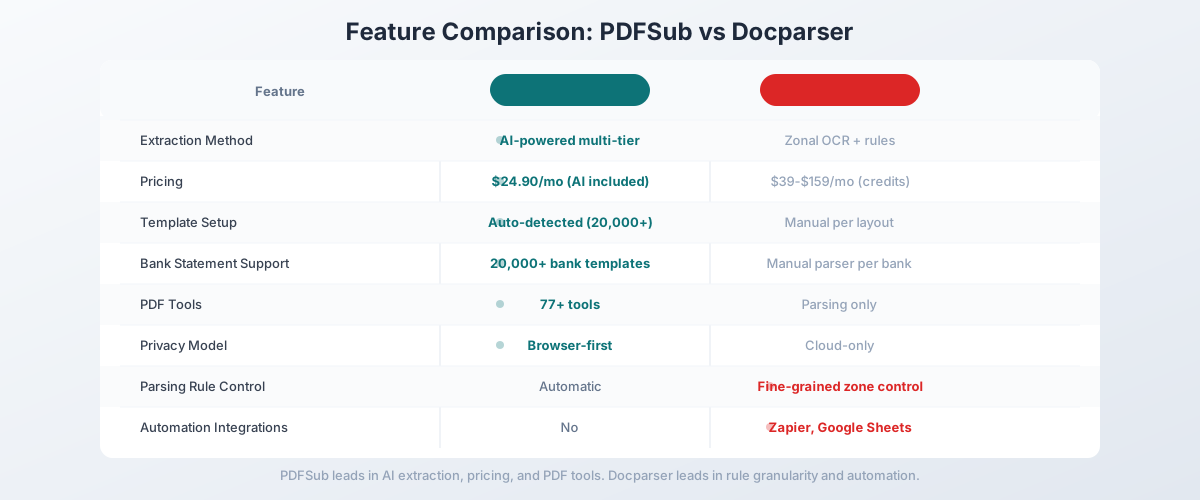
Side-by-Side Feature Comparison
| Feature | PDFSub | Docparser |
|---|---|---|
| Pricing | $20/mo (annual; $25/mo monthly) | $39-$159/mo |
| Extraction method | Multi-tier (pattern + AI) | Zonal OCR + template rules |
| AI-powered | Yes (Gemini AI) | No |
| Template creation | Auto-detected (20,000+ banks) | Manual (per layout) |
| Bank statement templates | 20,000+ pre-built | Manual parser per bank |
| PDF tools | 98+ (merge, split, compress, etc.) | Parsing only |
| Languages | 130+ (auto-detected) | OCR-dependent |
| Privacy model | Browser-first (Tier 1) | Cloud-only |
| Rule configuration | Not required | Required (drag-and-drop) |
| Automation integrations | No | Zapier, Google Sheets, webhooks |
| Export formats | Excel, CSV, QBO, OFX, JSON, + more | CSV, Excel, JSON, XML |
| Free trial | 7-day full access | 14-day trial |
When Docparser Is Still the Right Choice
Being honest: Docparser does things PDFSub doesn't. If these features are critical to your workflow, Docparser might still be the right tool:
You process highly consistent document formats. If your documents always come from the same sources with identical layouts (e.g., the same vendor sends the same invoice format every month), Docparser's Zonal OCR is reliable and predictable. Once a template works, it works consistently.
You need fine-grained parsing control. Docparser's drag-and-drop rule builder gives you precise control over extraction zones, text patterns, and table boundaries. If you need to extract specific fields from specific positions with exact formatting rules, Docparser's rule system provides this granularity.
You need automation integrations. Docparser connects to Zapier, Google Sheets, and webhooks for automated data routing. If parsed data needs to flow automatically into your systems without manual steps, Docparser's integration ecosystem enables this. PDFSub is designed for manual browser-based workflows.
You parse Word documents and images alongside PDFs. Docparser handles PDFs, Word documents, and images. PDFSub focuses primarily on PDF documents.
You need multi-layout parsers. Docparser lets you create multiple parsing rules within a single parser, handling documents with variable sections. If your documents have conditional layouts (e.g., some invoices have a discount section, others don't), Docparser's multi-layout parsing accommodates this.
Other Alternatives Worth Considering
PDFSub is our recommendation for the broadest value at an accessible price point, but other tools may fit specific needs:
Parsio - Email and document parsing with template-based extraction. Similar approach to Docparser but with email parsing as a core feature. $49-$299/month. Good if email ingestion is part of your workflow.
Nanonets - AI extraction with pre-trained models. More AI-driven than Docparser's rule-based approach. Good for teams that want machine learning without enterprise pricing.
Docsumo - AI document extraction with both API and browser interface. More expensive ($500+/month) but handles layout variations better than template-based tools.
Rossum - Enterprise IDP with template-free AI. Starting at $18,000/year. Overkill for small businesses but genuinely template-free extraction.
Amazon Textract - AWS's document extraction service. Pay-per-page with no minimums. Good for developer teams on AWS infrastructure.
How to Switch from Docparser to PDFSub
If you're currently using Docparser or evaluating it alongside PDFSub, here's how to make the transition:
Step 1: Start a Free Trial
Go to PDFSub's pricing page and start a 7-day free trial. Full functionality included.
Step 2: Test Your Core Document Types
Process the document types that drive your workflow:
- Bank statements: Upload statements from banks where you've created Docparser templates - verify that PDFSub's auto-detection matches or exceeds your manual parser accuracy
- Invoices: Test with invoices from your primary vendors - compare AI extraction against your Docparser parsing rules
- Receipts: Upload receipts including scanned/photographed versions
- Complex documents: Test documents that required extensive rule configuration in Docparser
Step 3: Evaluate Template Maintenance Savings
Count how many Docparser parsers you maintain and how often they need updates. With PDFSub's auto-detection and AI extraction, most of this maintenance disappears. The time savings alone often justify the switch.
Step 4: Compare Total Cost
Docparser's $39-$159/month versus PDFSub's $20/month (annual) All-In-One plan for AI extraction. Plus, you get 98+ PDF tools included in PDFSub that would require separate subscriptions alongside Docparser.
Step 5: Migrate Gradually
Start by processing new documents through PDFSub while keeping Docparser for any parsers that are working reliably. As you validate PDFSub's quality on each document type, shift volume from Docparser to PDFSub.
Frequently Asked Questions
Is PDFSub as accurate as Docparser for document extraction?
For financial documents (bank statements, invoices, receipts), PDFSub's multi-tier extraction typically matches or exceeds Docparser's Zonal OCR accuracy - especially for documents where layout varies between sources. Docparser can be very accurate when templates are precisely configured for a specific layout. Process your actual documents during PDFSub's 7-day free trial to compare.
Does PDFSub support parsing rules?
PDFSub doesn't use zone-based parsing rules. Extraction is automatic - pattern matching for Tier 1, layout analysis for Tier 2, and AI understanding for Tiers 3-4. This eliminates rule configuration but also means you have less granular control over extraction zones compared to Docparser.
Can PDFSub connect to Zapier or Google Sheets?
PDFSub is designed as a browser-first platform for manual document processing. It doesn't offer the automation integrations that Docparser provides. If automated data routing to external systems is essential, Docparser's integration layer is more developed.
Does PDFSub handle Word documents and images?
PDFSub's extraction focuses on PDF documents. Image-based documents (scanned PDFs) are supported through Tiers 2-4. Direct Word document parsing is not PDFSub's primary use case - Docparser handles Word files natively.
How does PDFSub handle documents without a matching template?
For bank statements, PDFSub has 20,000+ pre-built templates. If a specific bank isn't covered, Tiers 3-4 (AI extraction) read the document without a template. For invoices and receipts, AI extraction doesn't require templates at all - it understands document structure semantically.
Will my Docparser templates work in PDFSub?
Docparser templates aren't transferable to PDFSub since PDFSub uses a fundamentally different extraction approach. However, PDFSub's auto-detection and AI extraction typically eliminate the need for templates entirely - you get comparable or better results without template creation.
The Bottom Line
Docparser is a reliable template-based parser for consistent document formats, but its Zonal OCR limitations, per-layout template requirement, lack of AI, and pricing that starts at $39/month for just 100 credits create friction for growing practices. You shouldn't need to create a new parser template every time you encounter a new bank statement format.
PDFSub delivers AI-powered extraction for bank statements, invoices, and receipts with automatic format detection, no template maintenance, transparent All-In-One pricing at $20/month (annual; $240/year) or $25/month billed monthly, and 98+ PDF tools included. Add 130+ language support, 20,000+ bank statement templates, and browser-first privacy, and you get a modern document platform that eliminates the limitations of Zonal OCR.
Try PDFSub's bank statement converter free with a 7-day trial and process your actual documents. No parsing rules to configure, no templates to maintain, no zone coordinates to set - just upload and extract.