Best AutoEntry Alternative for Invoice Data Entry (2026)
Compare AutoEntry vs PDFSub for automated data entry. See credit costs, features, and alternatives.
PDFSub is best for:
- Accountants frustrated by AutoEntry's credit system who want flat-rate pricing at $20/user/mo (annual)
- Firms needing bank statement conversion and invoice extraction in one platform - not just receipt capture
- Users who want 98+ PDF tools (merge, split, translate, summarize) alongside financial extraction
- Browser-based document processing for privacy-sensitive financial data
PDFSub is NOT best for:
- Practices that rely on direct auto-publish to Sage, Xero, or QuickBooks (PDFSub exports files for manual import)
- Firms needing automated chart-of-accounts coding and supplier rule matching
- Teams requiring a mobile app to snap and auto-process receipts on the go
AutoEntry is a data entry automation tool owned by Sage that extracts data from invoices, receipts, and bank statements, then publishes it to accounting software. It uses OCR and AI to read financial documents and eliminate manual data entry. For bookkeepers and accountants running Sage, Xero, or QuickBooks practices, AutoEntry has been a reliable choice for years.
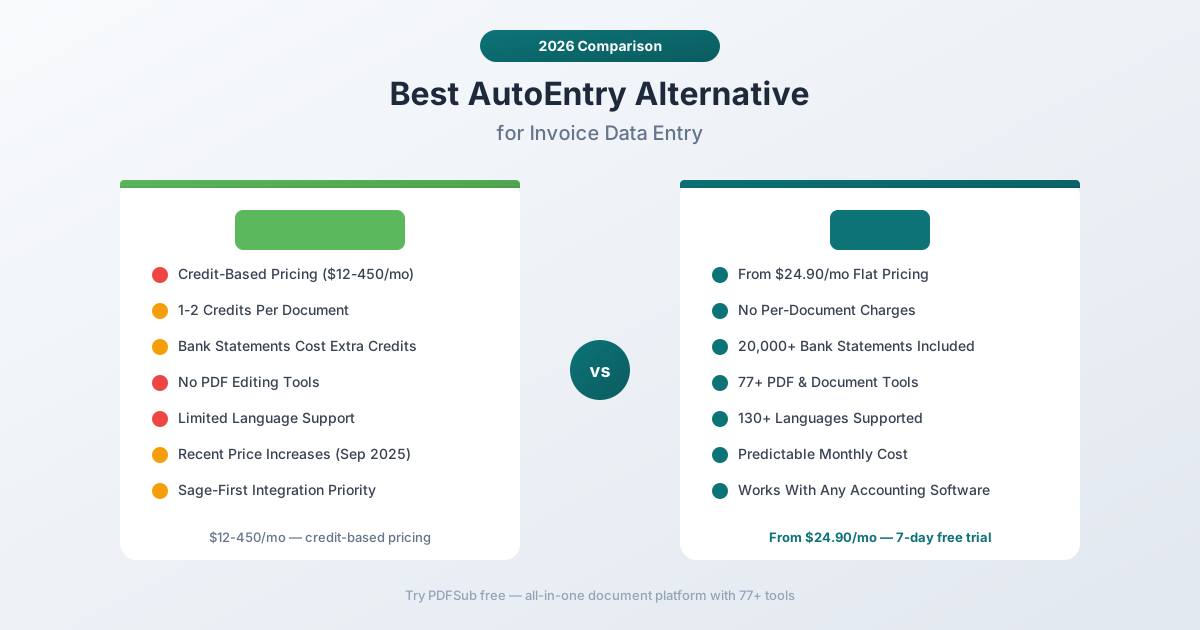
But AutoEntry runs on a credit system that makes costs unpredictable. Each document costs 1-2 credits to process, and credit packages range from $12/month (50 credits) to $450/month (3,000+ credits). At 2 credits per invoice with line items, a practice processing 200 invoices per month burns through 400 credits - that's the $98/month Platinum plan. The credit math gets worse as your volume grows.
If you've been frustrated by AutoEntry's credit system eating into your margins, its limited scope beyond invoice capture, or the September 2025 price increases, this guide compares alternatives and identifies where you get the best value.
Why People Look for AutoEntry Alternatives
AutoEntry works well at what it does - the extraction quality for invoices and receipts is solid. The complaints center on pricing structure, scope limitations, and the growing cost burden as practices scale.
Credit-Based Pricing Is Unpredictable
AutoEntry's credit system works like this:
- 1 credit per simple invoice or receipt (header data only)
- 2 credits per invoice or receipt with line items
- More credits for bank statements due to higher extraction volume
Credit packages:
| Plan | Credits/Month | Price/Month | Cost Per Credit |
|---|---|---|---|
| Bronze | 50 | $12 | $0.24 |
| Silver | 100 | $23 | $0.23 |
| Gold | 200 | $44 | $0.22 |
| Platinum | 500 | $98 | $0.20 |
| Diamond | 1,500 | $285 | $0.19 |
| Sapphire | 3,000+ | $450 | $0.15 |
The problem isn't the unit cost - it's the unpredictability. A month with 180 invoices fits comfortably in Gold. A month with 250 invoices pushes you to Platinum. Seasonal variations, new clients, or a few multi-page documents can push you into a higher tier unexpectedly.
And the September 2025 price increases made every tier more expensive, without adding new capabilities.
PDFSub uses simple per-user monthly pricing on its single All-In-One plan: $20/month (annual; $240/year, saves $60) or $25/month billed monthly. Includes 500 AI credits, 500 bank statement pages, and 98+ tools. No credits to count, no per-document charges, no surprises. Process 50 documents or 500 - the price stays the same.
Invoice and Receipt Focused - Limited Scope
AutoEntry handles invoices, receipts, and basic bank statement processing. But it doesn't:
- Merge, split, or compress PDFs
- Convert between document formats (Word, Excel, PowerPoint)
- Translate documents between languages
- Summarize or analyze documents with AI
- Watermark or encrypt PDFs
- Compare two documents side by side
For accounting practices, document processing extends well beyond invoice capture. Combining client documents, compressing files for email, converting between formats, and managing PDFs are daily tasks. AutoEntry covers one piece of this workflow.
PDFSub includes 98+ PDF and document tools alongside its AI extraction capabilities. One platform, one subscription, one workflow.
Bank Statement Processing Costs More Credits
AutoEntry can process bank statements, but the credit consumption is higher than for invoices because of the higher data volume per page. A 10-page bank statement with 150 transactions consumes significantly more credits than a single invoice.
For bookkeepers who regularly convert bank statements, the credit burn rate on statements can consume a significant portion of your monthly allocation, leaving fewer credits for invoice processing.
PDFSub's bank statement converter handles statements from 20,000+ banks worldwide with no per-statement or per-page charges. Convert as many statements as you need - the flat monthly price covers everything.
Limited Language Support
AutoEntry focuses primarily on English-language documents. It supports additional languages, but the accuracy for non-English text - particularly non-Latin scripts like Chinese, Japanese, Korean, Arabic, and Hindi - is inconsistent.
For practices with international clients, this means manual data entry for documents AutoEntry can't handle accurately.
PDFSub supports 130+ languages with automatic detection, including all non-Latin scripts. International date formats, number formats, and currency symbols are handled automatically.
Sage Integration Priority
As a Sage-owned product, AutoEntry's deepest integration is with Sage products. It also integrates with Xero and QuickBooks, but the Sage integration gets the most development attention. If you're not in the Sage ecosystem, you may not be getting the best experience.
PDFSub exports to standard file formats (Excel, CSV, QBO, OFX, QFX, QIF) that work with any accounting software. No priority given to any specific platform - the same workflow works universally.
What to Look for in an AutoEntry Alternative
Predictable pricing. Credit-based systems create uncertainty. Look for flat monthly pricing where your cost stays the same regardless of document volume.
Broader document coverage. Invoice and receipt capture is one task. The ideal tool handles all financial documents plus general PDF operations under one subscription.
Bank statement conversion without extra cost. If bank statements consume a disproportionate number of credits, your tool's pricing model doesn't match your workflow.
Language support. International documents need comprehensive language support, not just English plus a few European languages.
Privacy options. Financial documents are sensitive. Browser-first processing offers meaningful privacy advantages.
Output format flexibility. Standard formats (Excel, CSV, QBO, OFX) that work with any accounting software, not just preferred integrations.
PDFSub: The Best AutoEntry Alternative
PDFSub replaces AutoEntry's credit-based extraction with flat monthly pricing - AI extraction for invoices, receipts, and bank statements, plus 98+ PDF tools, without per-document charges.
Flat Pricing vs. Credit System
The most immediate difference is the pricing model. AutoEntry charges per document via credits. PDFSub charges a flat monthly rate.
Compare the cost at different volumes:
| Monthly Volume | AutoEntry (est.) | PDFSub |
|---|---|---|
| 50 invoices (simple) | $12/mo (Bronze) | $25-$45/mo |
| 100 invoices (with line items) | $44/mo (Gold) | $25-$45/mo |
| 200 invoices (with line items) | $98/mo (Platinum) | $25-$45/mo |
| 500 invoices (mixed) | $285/mo (Diamond) | $25-$45/mo |
At low volumes, AutoEntry's Bronze plan is cheaper. But as soon as you process more than about 100 invoices with line items per month, PDFSub's flat pricing becomes significantly more economical. And PDFSub includes bank statement conversion and 98+ PDF tools that AutoEntry doesn't offer.
Invoices + Receipts + Bank Statements
AutoEntry handles all three document types, but bank statements cost extra credits. PDFSub handles all three with no per-document charges:
Receipt scanning. The AI receipt scanner extracts merchant name, date, items, subtotal, tax, tip, and total from any receipt format in 130+ languages.
Invoice extraction. The AI invoice extractor pulls vendor details, invoice number, dates, line items with quantities and unit prices, amounts, tax details, and payment terms from any invoice layout.
Bank statement conversion. The bank statement converter handles statements from 20,000+ banks worldwide with exports to 8 formats: Excel, CSV, TSV, JSON, QBO, OFX, QFX, and QIF. No credit consumption, no per-page charges.
98+ PDF Tools Included
Beyond financial document extraction, PDFSub includes a comprehensive document platform:
- Merge and split PDFs for client document packages
- Compress large files for email or storage
- Convert between PDF, Word, Excel, PowerPoint, and image formats
- Watermark and stamp documents for confidential marking
- Encrypt and decrypt PDFs for security
- Translate documents across 130+ languages with AI
- Summarize long documents for quick review
- Compare two documents side by side
AutoEntry is extraction-only. Every other document operation requires a separate tool and subscription. With PDFSub, extraction and document management live in the same platform.
130+ Languages vs. Limited Support
PDFSub supports 130+ languages with automatic detection - including all non-Latin scripts (Chinese, Japanese, Korean, Arabic, Hindi, Thai, Cyrillic). International date formats, number formats (European comma-decimal, Indian lakh system), and 100+ currency symbols are handled automatically.
AutoEntry focuses on English and major European languages. Documents in non-Latin scripts often require manual data entry because the OCR accuracy is insufficient.
Browser-First Privacy
PDFSub's Tier 1 extraction runs entirely in your browser - your document never leaves your device. For most digital bank statements, invoices, and receipts, all processing happens client-side.
AutoEntry uploads all documents to cloud servers for processing. For practices handling sensitive client financial data, browser-first processing is a meaningful privacy advantage.
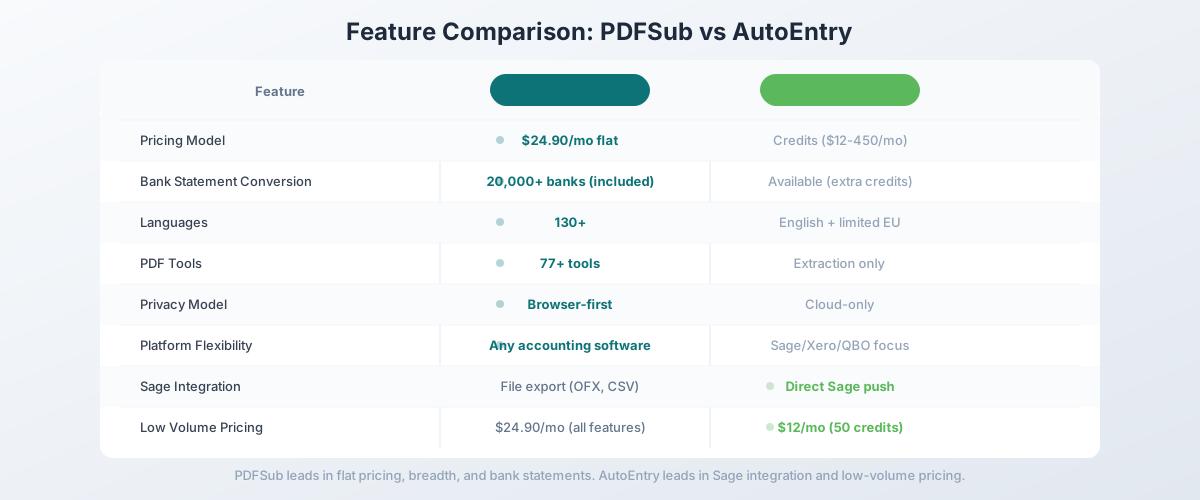
Side-by-Side Feature Comparison
| Feature | PDFSub | AutoEntry |
|---|---|---|
| Pricing model | $20/user/mo annual ($25/user/mo monthly) - predictable per-user seat | Credits ($12-450/mo) |
| Cost per document | No per-document fees within the 500-page/mo allocation per user | 1-2 credits ($0.15-0.24 each) |
| Bank statement conversion | 20,000+ banks, 8 formats (included) | Available (extra credits) |
| PDF tools | 98+ (merge, split, compress, convert, etc.) | None |
| Languages | 130+ (auto-detected) | English + limited EU languages |
| Privacy model | Browser-first (Tier 1 never uploads) | Cloud-only |
| Output formats | Excel, CSV, TSV, JSON, QBO, OFX, QFX, QIF | Accounting software push, CSV |
| Accounting integrations | File export (any software) | Sage, Xero, QuickBooks direct |
| Document types | Invoices, receipts, bank statements, reports | Invoices, receipts, bank statements |
| Unlimited companies | Yes | Yes (all plans) |
| Free trial | 7-day full access | Free trial available |
When AutoEntry Is Still the Right Choice
Being honest: AutoEntry does some things better than PDFSub. If these features are critical to your workflow, AutoEntry might still be the right tool:
You need direct Sage integration. As a Sage-owned product, AutoEntry has the deepest integration with Sage 50, Sage Business Cloud, and other Sage products. If your practice runs on Sage and you want one-click publishing of extracted data, AutoEntry's Sage integration is a genuine advantage that PDFSub can't match.
You process low volume with simple invoices. At 50 simple invoices per month (no line items), AutoEntry's Bronze plan at $12/month is cheaper than PDFSub's $20/month All-In-One plan. If your volume is consistently low and you don't need bank statement conversion or PDF tools, AutoEntry's entry-level pricing is competitive.
You want direct accounting software push. AutoEntry publishes extracted data directly to Xero, QuickBooks, and Sage without file export/import. PDFSub exports files that you import manually. If the one-click push eliminates meaningful time in your workflow, AutoEntry's direct integrations are valuable.
Your team is already trained on AutoEntry. Switching tools has a training cost. If your team is proficient with AutoEntry and the credit costs aren't a significant concern, the switching overhead may not be justified.
You need expense management features. AutoEntry includes expense tracking and management features beyond basic extraction. If your workflow includes employee expense submissions and approvals, AutoEntry's expense management is more mature.
Other Alternatives Worth Considering
PDFSub is our recommendation for the broadest value, but other tools may fit specific needs:
Dext Prepare - The most direct AutoEntry competitor. Receipt and invoice capture with direct accounting software sync (Xero, QuickBooks, Sage). Per-client pricing ($25-55/mo per client) that's more expensive than AutoEntry at scale, but the product is polished and well-maintained.
Hubdoc - Free with Xero subscriptions. Basic bill and receipt capture with direct Xero sync. Doesn't support line items, has accuracy issues, but the price is right if you're already paying for Xero.
Expensify - Expense management platform with receipt scanning. Better for corporate expense tracking than accounting practice use. Per-user pricing ($5-18/user/month). Different use case but sometimes compared.
DocuClipper - Specialized bank statement converter. Good if bank statements are your primary pain point. English-focused, page-based pricing ($39-$399/month). Complements AutoEntry rather than replacing it.
How to Switch from AutoEntry to PDFSub
Switching is straightforward - no data migration needed since both tools process documents on demand.
Step 1: Start a Free Trial
Go to PDFSub's pricing page and start a 7-day free trial. All plans include full functionality during the trial.
Step 2: Test Your Core Document Types
Process the documents you handle most frequently:
- Invoices: Test with invoices from your primary vendors - verify header data AND line item extraction
- Receipts: Upload receipts and compare extraction quality
- Bank statements: Convert client bank statements and verify transaction accuracy across multiple bank formats
- Non-English documents: If you handle international clients, test with their documents
Step 3: Compare Output Quality
For invoices, compare PDFSub's extracted fields against what AutoEntry produces. For bank statements, verify the exported QBO or OFX file imports cleanly into your accounting software. Pay attention to line item accuracy - this is where extraction tools differentiate.
Step 4: Calculate Total Cost
Add up your actual AutoEntry credit consumption over the past 3-6 months. Calculate the average monthly cost including any overage charges. Compare to PDFSub's per-user rate. Factor in tools you pay for separately (PDF editing, bank statement conversion at extra credit cost) that PDFSub would consolidate.
Step 5: Adjust Your Workflow
The main workflow change is shifting from direct accounting software push (AutoEntry) to file export and import (PDFSub). The QBO files work natively with QuickBooks, OFX files work with Xero and most other platforms, and Excel/CSV files are universal. The import step adds a few seconds per batch but eliminates per-document credit costs.
Step 6: Cancel AutoEntry
Once you've verified PDFSub covers your workflow, cancel your AutoEntry subscription. AutoEntry offers no-contract cancellation, so you can cancel any time.
Frequently Asked Questions
Is PDFSub as accurate as AutoEntry for invoice extraction?
Both tools deliver strong extraction accuracy for standard invoices. AutoEntry has been focused exclusively on invoice/receipt extraction for years, which gives it a deep library of learned formats. PDFSub's multi-tier extraction (browser-based for digital PDFs, AI-powered for scanned documents) delivers comparable accuracy for most invoice layouts. Test with your actual documents during PDFSub's 7-day free trial.
Can PDFSub push data directly into Sage?
No. PDFSub exports files in standard formats (QBO, OFX, Excel, CSV) that you import into your accounting software manually. AutoEntry's direct Sage integration is a genuine advantage if you're in the Sage ecosystem. The tradeoff is that PDFSub's file exports work with any accounting software, while AutoEntry's direct push is limited to its supported platforms.
How does PDFSub handle bank statements compared to AutoEntry?
PDFSub comes pre-loaded with templates for 20,000+ banks worldwide. Upload a statement, and the system auto-detects the bank format and extracts all transactions. Export to 8 formats including QBO and OFX. AutoEntry processes bank statements but consumes more credits per statement due to the higher data volume. PDFSub's flat pricing means bank statements don't cost extra.
Will PDFSub work with my accounting software?
PDFSub exports to QBO (QuickBooks native), OFX (Xero, Sage, and most platforms), Excel, CSV, TSV, JSON, QFX, and QIF. If your accounting software can import any of these standard formats, PDFSub will work with it. AutoEntry has direct push integrations with specific platforms, which is more convenient but less flexible.
Is AutoEntry cheaper than PDFSub at low volume?
At very low volume, AutoEntry's Bronze plan (50 credits, $12/month) is cheaper than PDFSub's All-In-One plan ($20/month annual; $25/month monthly, 500 AI credits). But PDFSub includes 98+ PDF tools, bank statement conversion, e-sign; add unlimited team seats at the same per-user rate in one subscription. The value per dollar favors PDFSub once you need more than a handful of documents.
The Bottom Line
AutoEntry is a capable invoice and receipt extraction tool - but its credit-based pricing makes costs unpredictable, bank statements burn credits disproportionately, and the September 2025 price increases made every tier more expensive. You're paying per document in a world where per-document pricing punishes practice growth.
PDFSub delivers AI-powered extraction for invoices, receipts, and bank statements with the All-In-One plan at $20/month (annual; $240/year) or $25/month billed monthly - no credits, no per-document charges, no surprises. Add 98+ PDF tools, 130+ language support, 20,000+ bank statement templates, and browser-first privacy, and you get a comprehensive platform that covers the full document workflow.
Try PDFSub free with a 7-day trial and process your actual invoices, receipts, and bank statements. Compare the extraction quality and calculate how much you'd save versus your current AutoEntry credit consumption. The flat pricing math tends to be convincing.