AI-Powered Financial Statement Analysis: A Complete Guide
Financial statement analysis takes hours of manual work - gathering documents, keying in numbers, calculating ratios, comparing periods. AI compresses the entire workflow into minutes. Here's how it works, what it can and can't do, and how to get started.
A competent financial analyst can review a company's income statement, balance sheet, and cash flow statement in about four to six hours. They'll calculate two dozen ratios, compare them against prior periods, benchmark against industry averages, and write a narrative that explains what the numbers mean. It's skilled work. It's also the kind of structured, repeatable process that AI handles exceptionally well.
The finance AI market is projected to reach $22.6 billion by 2025, and Gartner predicts that 90% of finance teams will deploy at least one AI-enabled solution by 2026. Yet a CPA Practice Advisor report found that while 76% of finance leaders plan to invest in AI automation, only 6% have achieved broad-scale implementation. The gap between intention and execution is enormous - and it starts with understanding what AI-powered financial statement analysis actually involves.
This guide covers the fundamentals: what financial statements contain, how analysis has traditionally been done, how AI transforms each step of the process, and where the technology falls short. Whether you're an accountant evaluating new tools, a business owner trying to understand your own financials, or a student learning the discipline, this is a practical walkthrough of the current state of the art.
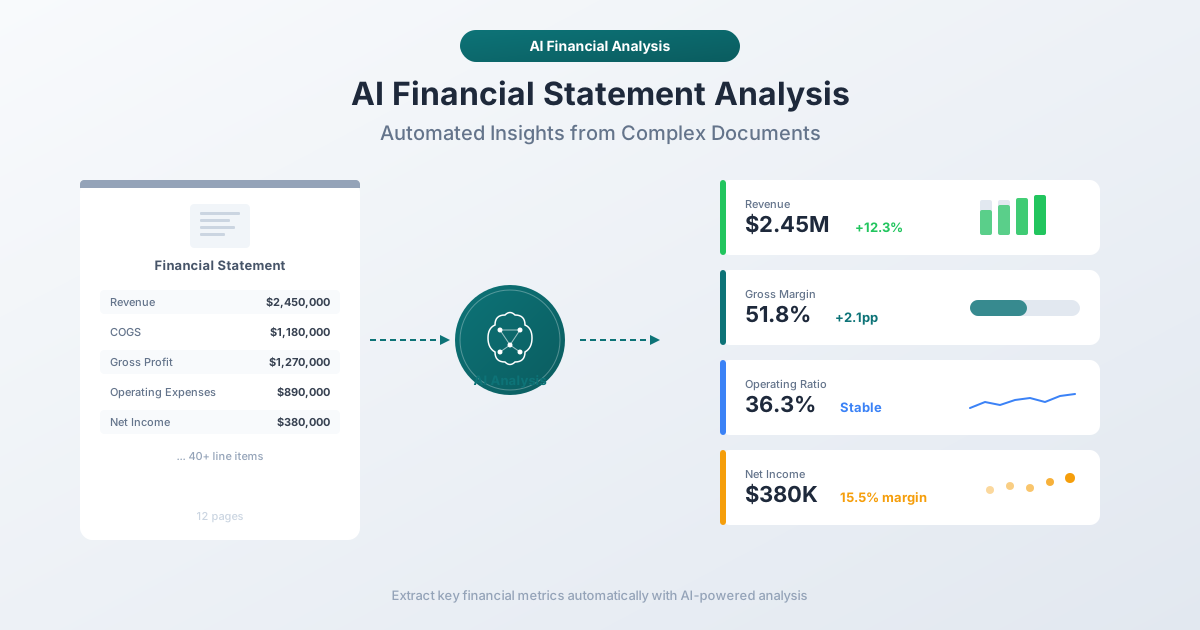
The Three Core Financial Statements
Every financial statement analysis starts with three documents that together tell the complete story of a company's financial health.
The Income Statement (Profit & Loss)
The income statement answers: did the company make money during this period? It starts with revenue at the top and subtracts costs in layers - cost of goods sold, operating expenses, interest, taxes - until you arrive at net income at the bottom. Key line items include revenue, COGS, gross profit, operating expenses, operating income (EBIT), interest expense, and net income.
The Balance Sheet
The balance sheet answers: what does the company own, what does it owe, and what's left for shareholders? It's a snapshot of a single moment in time. The fundamental equation is:
Assets = Liabilities + Shareholders' Equity
Current assets (cash, receivables, inventory) and non-current assets (property, equipment, goodwill) sit on one side. Current liabilities (payables, short-term debt) and non-current liabilities (long-term debt, pensions) plus shareholders' equity sit on the other.
The Cash Flow Statement
The cash flow statement answers: where did the cash actually come from and where did it go? A company can be profitable on paper while running out of cash - which is why this statement exists. It tracks cash movement across operating activities, investing activities, and financing activities.
Why all three matter together: A company with strong revenue growth (income statement) but deteriorating cash flow (cash flow statement) and rising debt (balance sheet) tells a very different story than one where all three align positively. Financial statement analysis is about reading these documents as a system, not in isolation.
The Traditional Analysis Workflow
For decades, financial statement analysis has followed six steps:
- Gather the statements - Collect income statements, balance sheets, and cash flow statements for two to five years. These typically arrive as PDFs or accounting software exports.
- Manual data entry - Key 250 to 750 numbers into a spreadsheet. This is where the bulk of time goes, and the 1 to 4% error rate for manual entry means 5 to 20 errors on 500 data points.
- Calculate ratios - Compute 15 to 25 financial ratios across liquidity, profitability, leverage, and efficiency categories.
- Compare periods - Place ratios side by side, calculate dollar and percentage changes, identify trends.
- Benchmark against standards - Compare ratios against industry averages, competitors, or internal targets.
- Write the narrative - Synthesize findings into a report that explains what the numbers mean. This step requires the most human judgment.
Total time for a thorough analysis: 4 to 8 hours for a single company. For an analyst covering 20 companies, that's 80 to 160 hours - two to four full work weeks - for one round of analysis.
How AI Transforms Each Step
AI doesn't replace the analysis workflow. It compresses it. Here's what changes at each stage.
Automated Extraction (Replacing Steps 1 and 2)
Instead of manually keying 500+ numbers from PDF financial statements, AI-powered extraction reads the documents and pulls structured data automatically. Modern systems achieve 99%+ field-level accuracy on digital PDFs through a layered approach: text extraction, table structure detection, field classification (mapping values to categories like revenue, COGS, total assets), and validation cross-checks (verifying that Assets = Liabilities + Equity, and that subtotals add up).
What used to take 30 to 60 minutes per statement now takes seconds, with error rates dropping from 1-4% (manual entry) to well under 1%.
Instant Ratio Calculation (Replacing Step 3)
Once data is extracted and structured, AI calculates every standard ratio simultaneously - no formula errors, no missed cells. It also adds contextual ratio selection: a manufacturing company's analysis emphasizes inventory turnover and gross margins, while a SaaS company's focuses on recurring revenue metrics. The AI adapts the framework to the business type.
Automated Trend Detection (Replacing Step 4)
AI processes multi-period data simultaneously, flagging seasonal patterns, inflection points, divergences between related metrics (revenue growing while cash from operations shrinks), and anomalies that break from historical patterns.
Narrative Generation (Augmenting Step 6)
Modern AI produces a first draft of the analytical narrative - summarizing findings, highlighting trends, and providing context for ratio changes. However, this is also where AI's limitations become most apparent.
Key Financial Ratios AI Can Calculate
Here's a reference table of the ratios that form the backbone of financial statement analysis, organized by category. AI systems can calculate all of these instantly once the underlying data is extracted.
Liquidity Ratios
Liquidity ratios measure a company's ability to meet its short-term obligations. Can it pay its bills?
| Ratio | Formula | What It Tells You | Typical Benchmark |
|---|---|---|---|
| Current Ratio | Current Assets / Current Liabilities | Overall short-term solvency | 1.5 to 3.0 (varies by industry) |
| Quick Ratio | (Current Assets - Inventory) / Current Liabilities | Solvency without relying on inventory sales | 1.0 or higher |
| Cash Ratio | Cash & Equivalents / Current Liabilities | Most conservative liquidity measure | 0.5 to 1.0 |
Example: A company with $500,000 in current assets and $250,000 in current liabilities has a current ratio of 2.0 - meaning it has $2 of short-term assets for every $1 of short-term obligations. That's generally healthy, but a current ratio of 5.0 might suggest the company is holding too much idle cash.
Profitability Ratios
Profitability ratios measure how efficiently a company converts revenue into profit at various stages.
| Ratio | Formula | What It Tells You | Typical Benchmark |
|---|---|---|---|
| Gross Margin | (Revenue - COGS) / Revenue | Profitability of core production | 20% to 60% (highly industry-dependent) |
| Operating Margin | Operating Income / Revenue | Profitability after all operating costs | 10% to 25% |
| Net Profit Margin | Net Income / Revenue | Bottom-line profitability | 5% to 20% |
| Return on Assets (ROA) | Net Income / Total Assets | How effectively assets generate profit | 5% to 15% |
| Return on Equity (ROE) | Net Income / Shareholders' Equity | Return generated for shareholders | 10% to 25% |
Leverage Ratios
Leverage ratios measure how much the company relies on debt versus equity to finance its operations.
| Ratio | Formula | What It Tells You | Typical Benchmark |
|---|---|---|---|
| Debt-to-Equity | Total Liabilities / Shareholders' Equity | Balance of debt vs. owner financing | 0.5 to 2.0 (industry-dependent) |
| Debt Ratio | Total Liabilities / Total Assets | Proportion of assets financed by debt | 0.3 to 0.6 |
| Interest Coverage | Operating Income / Interest Expense | Ability to service debt payments | 3.0 or higher |
Efficiency Ratios
Efficiency ratios measure how well the company uses its assets and manages its operations.
| Ratio | Formula | What It Tells You | Typical Benchmark |
|---|---|---|---|
| Asset Turnover | Revenue / Total Assets | Revenue generated per dollar of assets | 0.5 to 2.5 |
| Inventory Turnover | COGS / Average Inventory | How quickly inventory sells | 4 to 12 (retail/manufacturing) |
| Receivables Turnover | Revenue / Average Accounts Receivable | How quickly customers pay | 6 to 12 |
| Days Sales Outstanding | 365 / Receivables Turnover | Average collection period in days | 30 to 60 days |
Three Methods of Financial Statement Analysis
AI handles each of these three standard analysis methods, but the approach and value differ.
Horizontal Analysis (Trend Analysis)
Horizontal analysis compares the same line items across multiple time periods. It answers: how are things changing over time?
Formulas:
- Dollar Change = Current Period Amount - Base Period Amount
- Percentage Change = (Current Period - Base Period) / Base Period x 100
What AI adds: Speed and completeness. A human analyst might calculate horizontal changes for 20 key line items. AI calculates them for every line item across every period - often revealing trends in minor expense categories that a manual analysis would skip.
| Line Item | 2024 | 2025 | $ Change | % Change |
|---|---|---|---|---|
| Revenue | $2,400,000 | $2,760,000 | +$360,000 | +15.0% |
| COGS | $1,440,000 | $1,711,200 | +$271,200 | +18.8% |
| Gross Profit | $960,000 | $1,048,800 | +$88,800 | +9.3% |
| Operating Expenses | $600,000 | $690,000 | +$90,000 | +15.0% |
| Net Income | $240,000 | $230,400 | -$9,600 | -4.0% |
Revenue grew 15% but COGS grew faster at 18.8%, compressing gross margin. Despite operating expenses matching revenue growth, net income declined 4%. An AI system flags this divergence immediately.
Vertical Analysis (Common-Size Analysis)
Vertical analysis expresses each line item as a percentage of a base figure - typically revenue for the income statement and total assets for the balance sheet. It answers: what's the relative composition of the financial statements?
Formula:
- Common-Size Percentage = Line Item Amount / Base Amount x 100
What AI adds: Instant comparability. When every line item is expressed as a percentage, you can compare companies of vastly different sizes, or compare a company against industry benchmarks, on equal footing.
| Income Statement Line | Amount | % of Revenue |
|---|---|---|
| Revenue | $2,760,000 | 100.0% |
| COGS | $1,711,200 | 62.0% |
| Gross Profit | $1,048,800 | 38.0% |
| Operating Expenses | $690,000 | 25.0% |
| Operating Income | $358,800 | 13.0% |
| Net Income | $230,400 | 8.3% |
A net margin of 8.3% might look fine in isolation. But if the industry average is 12%, the vertical analysis immediately highlights a profitability gap that warrants investigation.
Ratio Analysis with Industry Benchmarking
Ratio analysis calculates the financial ratios described above and compares them against benchmarks - industry averages, competitor metrics, or the company's own historical performance.
What AI adds: Automated benchmarking. AI systems can pull industry average ratios from databases and flag where a company falls outside normal ranges. Instead of manually looking up benchmarks for each ratio, the analyst receives a pre-flagged report highlighting areas of concern or strength.
| Ratio | Company | Industry Average | Status |
|---|---|---|---|
| Current Ratio | 2.1 | 1.8 | Above average |
| Quick Ratio | 0.9 | 1.2 | Below average |
| Gross Margin | 38.0% | 42.5% | Below average |
| Debt-to-Equity | 1.8 | 1.2 | Above average |
| ROE | 14.2% | 16.0% | Slightly below |
The company looks liquid (current ratio above average) but the quick ratio tells a different story - strip out inventory, and short-term solvency drops below the norm. AI flags the discrepancy; the analyst provides the interpretation.
What AI Can and Cannot Do
This is the section that matters most for anyone considering AI-powered analysis. The technology is powerful, but its boundaries are real.
What AI Does Well
Data extraction. AI reads financial statements from PDFs and structures the data with high accuracy. For clean digital documents, field-level accuracy exceeds 99%.
Calculation. Once data is structured, AI computes every ratio, percentage change, and common-size figure instantly and without arithmetic errors.
Pattern detection. AI processes multi-year datasets simultaneously and identifies trends, anomalies, and divergences that a human analyst working sequentially might overlook - like operating expenses growing 0.5% faster than revenue for six consecutive quarters.
Speed and consistency. What takes a human analyst 4 to 8 hours, AI completes in minutes. It applies the same methodology every time - no fatigue, no shortcuts on the fifteenth analysis of the day.
What AI Cannot Do
Judgment about management quality. Financial statements tell you what happened, not why. Was the revenue decline a strategic exit from a low-margin product line (potentially positive) or a loss of market share (definitely negative)? AI flags the decline; it cannot make the judgment call.
Strategic context. A debt-to-equity ratio spiking from 1.0 to 2.5 looks alarming in isolation. But if the company just acquired a competitor that will double its market share, the leverage increase might be perfectly rational. AI lacks the context from earnings calls, industry news, and competitive dynamics.
Forward-looking assessment. AI can project trends mathematically, but it cannot assess whether the conditions that produced historical growth will persist. A new competitor, regulatory change, or technology shift can invalidate any trend-based projection.
Accounting quality evaluation. Aggressive revenue recognition, capitalizing expenses that should be expensed, or timing transactions to flatter a period - AI might flag unusual patterns, but evaluating accounting appropriateness requires professional expertise.
Qualitative risk factors. Customer concentration, key-person dependency, pending litigation, brand strength - these materially affect financial health but don't appear directly in the numbers.
The bottom line: AI is an analyst's power tool, not a replacement analyst. It handles the mechanical work so the human can focus on judgment, context, and experience.
Real-World Applications
AI-powered financial statement analysis serves different purposes across different roles. Here are four primary use cases.
Loan Underwriting
Lenders evaluate borrower financial health by extracting data from submitted statements, calculating key ratios (debt service coverage, leverage, liquidity), and flagging accounts outside acceptable ranges. AI reduces a multi-day underwriting process to under an hour for standard commercial loans. A 2026 industry report found that AI-enabled systems automate up to 95% of manual underwriting decisions for SME lending.
Investment Screening
Portfolio managers covering 50 to 200 companies use AI to process quarterly filings as they're released, calculate updated ratios, compare against historical trends and peer companies, and surface the ones with material changes. Research firms report a 60% reduction in initial screening time compared to manual methods.
Audit Preparation
AI accelerates analytical procedures - calculating expected ratios based on industry data, flagging anomalies, and producing common-size analyses that highlight unusual account balances. It creates detailed audit trails documenting every extracted data point and its source, freeing audit teams to focus on judgment-intensive procedures.
Management Reporting
CFOs and controllers use AI to extract actuals from accounting exports, perform variance analysis against budgets and prior periods, and generate first-draft management reports. Finance teams reclaim up to 40% of the time previously spent on routine reporting.
Accuracy Considerations: Garbage In, Garbage Out
The oldest rule in computing applies directly to AI-powered financial analysis. The quality of your output depends entirely on the quality of your input.
Document Quality Matters
AI extraction accuracy varies dramatically based on document type:
| Document Type | Typical Accuracy | Notes |
|---|---|---|
| Native digital PDF (accounting software export) | 99%+ | Text layer is clean, structured, and machine-readable |
| High-quality scan (300+ DPI, straight, clear) | 95-98% | OCR handles well but minor errors in numbers are possible |
| Low-quality scan (skewed, faded, handwritten notes) | 80-90% | Significant error risk; manual verification essential |
| Photographed documents | 70-85% | Perspective distortion, shadows, and lighting variation degrade accuracy |
A 99% field-level accuracy rate sounds excellent - and it is. But consider this: a financial statement with 200 individual data points at 99% accuracy still has a statistical expectation of 2 errors. If one of those errors is in the revenue field, every ratio that uses revenue is wrong.
Verification Strategies
Smart analysts use AI output as a starting point, not a final answer:
- Balance checks - Does Assets = Liabilities + Equity? Do subtotals add up? If not, there's an extraction error.
- Trend reasonableness - A 300% revenue jump year over year is more likely an extraction artifact than reality.
- Cross-statement consistency - Net income should match changes in retained earnings (adjusted for dividends). Cash from operations should reconcile with working capital changes.
- Source document comparison - Spot-check 10 to 15 values against the original. If they all match, you can have reasonable confidence in the full extraction.
A Parseur study found that 31% of finance teams identify data integrity lapses as a core obstacle to accurate reporting. AI doesn't magically solve this - if a client sends draft statements instead of final versions, AI will faithfully extract and analyze the wrong numbers.
How PDFSub Helps with Financial Statement Analysis
PDFSub's Financial Report Analyzer is built specifically for this workflow. Upload a financial statement PDF - income statement, balance sheet, or cash flow statement - and the tool extracts the data, identifies the statement type, and produces structured analysis.
What It Does
- Extracts financial data from PDF statements, including complex multi-column layouts and statements with sub-totals at multiple levels
- Identifies key metrics - revenue, expenses, assets, liabilities, equity, and cash flows - and maps them to standard categories
- Calculates financial ratios across liquidity, profitability, leverage, and efficiency categories
- Highlights trends when multi-period statements are provided
- Generates narrative analysis summarizing the financial position, key strengths, and areas of concern
- Supports 130+ languages - financial statements from international subsidiaries, foreign clients, or multilingual organizations are handled natively
Privacy-First Processing
For clean digital PDFs, PDFSub processes the document directly in your browser. The file never leaves your device. For scanned or image-heavy PDFs that require AI vision processing, encrypted server-side processing handles the extraction, and your files are deleted after processing.
This matters for financial statement analysis because the documents contain sensitive business data - revenue figures, debt levels, profitability metrics. Client confidentiality isn't optional.
Getting Started
Start with a company whose financials you've already analyzed manually. Upload the PDF, compare 10 to 15 extracted values against the source document, verify the calculated ratios, and read the narrative analysis. This 20-minute verification gives you a calibrated sense of where AI adds value in your specific workflow.
Try PDFSub Free - upload a financial statement and see how AI-powered analysis compares to your manual process.
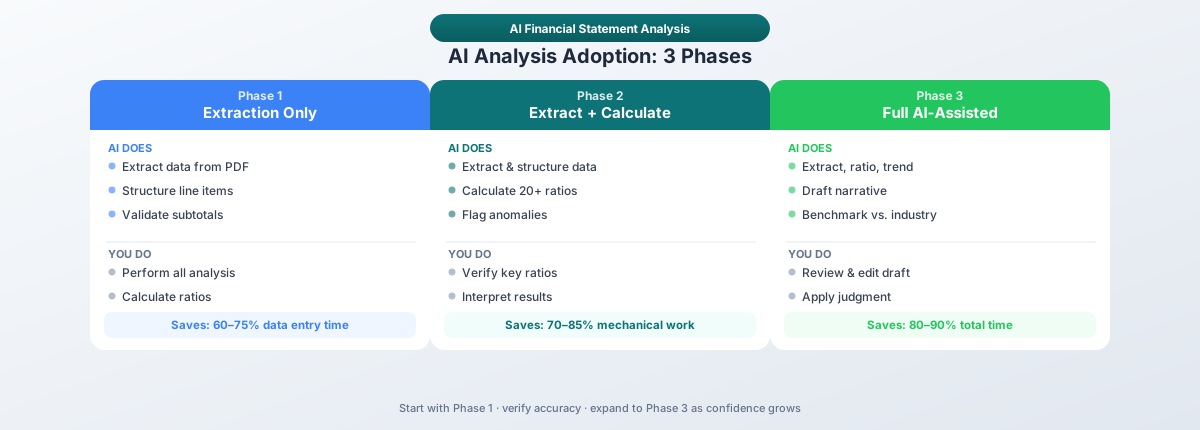
Getting Started with AI-Assisted Analysis
The transition to AI-assisted analysis doesn't require an all-or-nothing commitment. A phased approach builds confidence gradually.
| Phase | What AI Does | What You Do | Time Savings |
|---|---|---|---|
| 1. Extraction only | Extracts data from PDF statements | Perform all analysis yourself | 60-75% of data entry time |
| 2. Extraction + calculation | Extracts data and calculates ratios | Verify ratios, interpret results | 70-85% of mechanical work |
| 3. Full AI-assisted | Extraction, ratios, trends, draft narrative | Review, edit, add judgment and context | 80-90% of total analysis time |
Regardless of which phase you're in, never skip these steps:
- Verify extraction accuracy for critical values (revenue, net income, total assets, total liabilities)
- Check mathematical relationships (balance sheet equation, subtotal additions)
- Read the source documents - AI can extract and calculate, but you need to understand what the financial statements are actually saying
- Apply professional judgment - a ratio that AI flags as "below industry average" might be perfectly appropriate for this specific company's situation
The Bottom Line
Financial statement analysis is a discipline built on structured data, standardized ratios, and repeatable processes - exactly the kind of work where AI delivers the most value. The mechanical steps (extraction, calculation, comparison) are dramatically faster and more accurate with AI. The interpretive steps (judgment, context, strategy) remain firmly in human territory.
The technology isn't futuristic. It's available now, it's improving rapidly, and the early adopters - the analysts using AI to process 200 company filings while their peers are still manually keying in data - are operating at a structural advantage.
Start with extraction. Verify against what you know. Build from there.