Convert PNC Bank Statements to Excel (2026)
Step-by-step guide to converting PNC Bank checking, savings, and Virtual Wallet statement PDFs into Excel, CSV, or QBO format.
You've got a PNC Bank statement PDF and you need the data in a spreadsheet. Maybe you're reconciling accounts for a client, categorizing business expenses, or pulling together records for tax filing. Whatever the reason, PNC doesn't give you a clean path from statement to spreadsheet - and if you're a Virtual Wallet customer, the situation is even more complicated than you'd expect.
PNC Financial Services manages roughly $560 billion in assets, making it the seventh-largest bank in the United States. After acquiring BBVA USA in 2021 and FirstBank in January 2026, PNC expanded from its traditional East Coast footprint to a truly nationwide presence. Millions of customers rely on PNC for personal and business banking - and every one of them gets statements in PDF format. No native Excel option. No QBO export. And for Virtual Wallet customers - PNC's signature product that bundles Spend, Reserve, and Growth accounts into a single statement - there isn't even a CSV download.
Here's how to actually get your PNC statement data into Excel, with methods that work for checking, savings, Virtual Wallet, and business accounts.
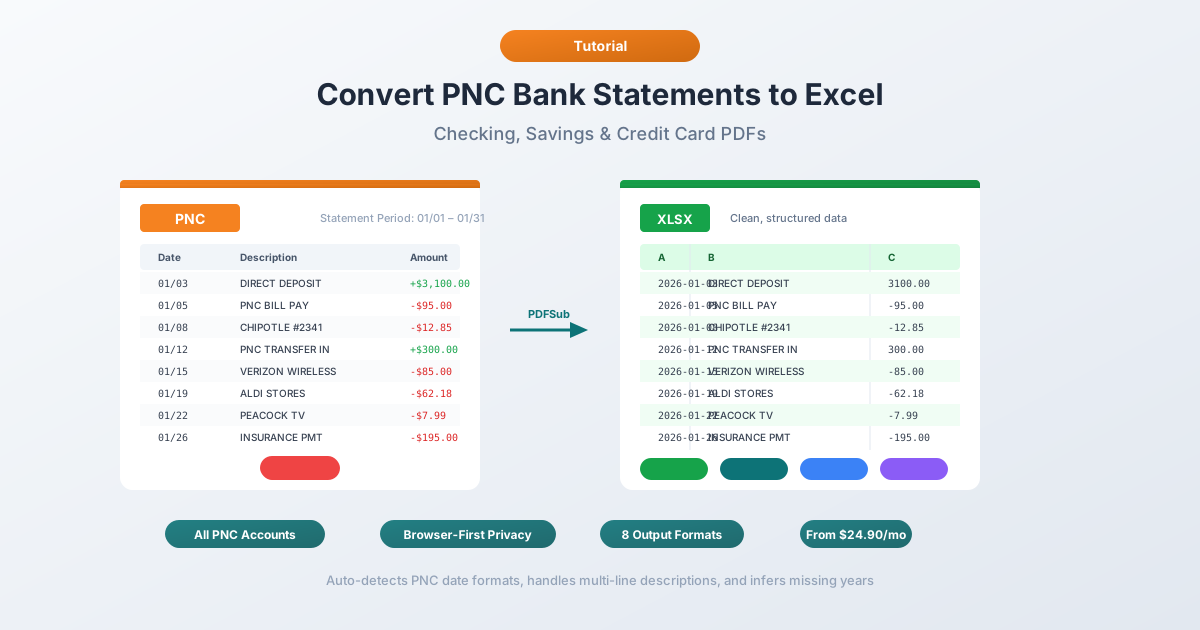
What PNC Gives You (And What It Doesn't)
Before converting anything, it helps to understand what PNC actually offers - and where the gaps are.
PDF statements - available through PNC Online Banking under Statements & Documents. These are the official statements matching what you'd receive in the mail. PDF format only, no alternative format for the official statement.
Activity downloads - available for standard checking and savings accounts through the Account Activity section on pnc.com. PNC offers CSV export for recent transaction activity. Sounds like it should solve the problem, right?
Not quite. The activity download has real limitations:
- 90-day history cap - PNC's CSV export covers only the most recent 90 days of transactions, far less than Chase (~24 months) or Wells Fargo (~18 months). For anything older, you need the PDF statements.
- No CSV for Virtual Wallet - PNC's flagship Virtual Wallet product does not support CSV download at all. If you have a Virtual Wallet account - and millions of PNC customers do - your only data source is the PDF statement.
- Not official statements - the CSV download is a transaction feed. It's missing opening/closing balances, fee summaries, interest breakdowns, and account summary sections.
- No QBO or OFX export - unlike Chase and Wells Fargo, PNC doesn't offer native QuickBooks or Quicken-compatible formats. QuickBooks and Xero users have no direct import path from PNC.
- No statement-level detail - items like monthly service fees, interest earned, and overdraft charges are summarized differently in the CSV than on the official statement.
The Virtual Wallet gap is especially painful. PNC markets Virtual Wallet as its premium consumer banking product, yet provides the fewest digital export options for it. If you need historical data, complete statement records, or accounting software compatibility - the PDF is your only option.
Method 1: Use a Bank Statement Converter (Recommended)
The fastest and most accurate method is a specialized bank statement converter - a tool designed specifically to extract transaction data from bank statement PDFs.
Unlike generic PDF-to-Excel tools, bank statement converters understand the structure of financial documents. They know that PNC checking statements use a 3-column layout with Date, Amount, and Description. They handle multi-line descriptions, section-based transaction grouping, and PNC's date formatting quirks. And critically, they can parse Virtual Wallet statements that contain three separate account sections - Spend, Reserve, and Growth - within a single PDF.
Step-by-Step with PDFSub
- Download your PNC statement - Log into pnc.com → Statements & Documents → select the statement → download PDF
- Go to PDFSub's Bank Statement Converter
- Upload the PNC PDF - drag and drop or click to browse
- Review the extracted data - PDFSub shows you the transactions before you download, so you can verify accuracy
- Choose your format - Excel (XLSX), CSV, QBO (QuickBooks), OFX (Xero), or any of 8 supported formats
- Download - click Download or use "Download All" for a ZIP with every format
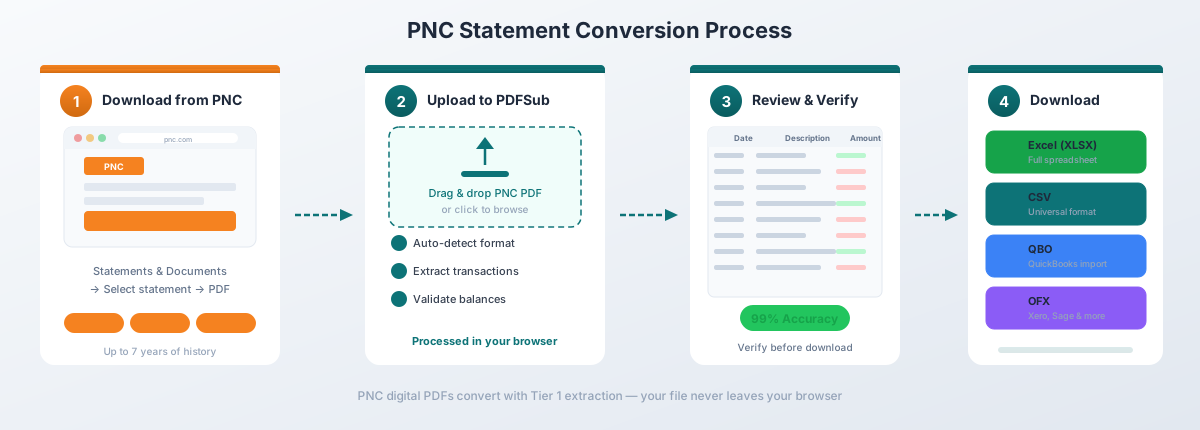
For PNC's digital PDFs (downloaded directly from Online Banking), PDFSub's Tier 1 extraction handles the conversion entirely in your browser - the file never leaves your device. This matters when you're working with sensitive financial data.
Why this works well for PNC specifically:
- Auto-detects PNC's 3-column layout and correctly maps Date, Amount, and Description fields
- Handles PNC's multi-line transaction descriptions without creating duplicate rows
- Recognizes section headers like "Deposits and Other Credits" and "Banking/Debit Card Withdrawals and Purchases" and skips them rather than treating them as transactions
- Parses Virtual Wallet statements and separates Spend, Reserve, and Growth account sections
- Works with all PNC account types - standard checking, savings, Virtual Wallet, and business accounts
- Exports to QBO format for direct QuickBooks import - filling the gap that PNC's native tools leave open
- Exports to OFX format for Xero and other accounting software
Bank statement conversion is included in the All-In-One plan at $20/user/mo (annual; 500 pages per user) with a 7-day free trial.
Method 2: PNC's Built-In Activity Download
If you have a standard checking or savings account (not Virtual Wallet) and only need recent transactions, PNC's native CSV export is the quickest option.
How to Download
- Log into pnc.com
- Navigate to your account
- Click "Account Activity" or "Transaction History"
- Set the date range for the transactions you need (maximum 90 days)
- Click "Download" and select CSV format
- Open the downloaded file in Excel
What You Get
PNC's CSV includes basic transaction data:
| Column | Description |
|---|---|
| Date | Transaction date (MM/DD/YYYY) |
| Amount | Signed amount (negative for debits) |
| Description | Merchant or transaction detail |
Limitations to Watch For
The 90-day history cap. This is one of the shortest download windows among major U.S. banks. Chase offers roughly 24 months, Wells Fargo about 18 months, and Bank of America around 18 months. PNC gives you just three months. For anything older, you need the PDF.
No Virtual Wallet support. If your account is a Virtual Wallet - which bundles Spend, Reserve, and Growth accounts - the CSV download option is not available. This is PNC's most popular consumer product, yet it has the fewest export options. Your only data source for Virtual Wallet is the PDF statement.
Not the official statement. The CSV export is a transaction feed - it doesn't include opening/closing balances, fee breakdowns, interest charges, or account summaries. If you need these for accounting or audit purposes, you need the PDF.
No QBO or OFX formats. PNC doesn't offer QuickBooks or Quicken-compatible download formats at all. If you need to import PNC data into accounting software, you'll need to either convert the PDF to QBO/OFX using a converter, or manually map the CSV columns during import.
This method works for quick personal finance tracking of the most recent 90 days on a standard account. For anything more comprehensive - or for any Virtual Wallet customer - you need to convert the PDF.
Method 3: Copy-Paste from PDF (Not Recommended)
You can try selecting text in a PNC PDF and pasting it into Excel. Here's what actually happens:
Everything lands in a single column. Dates, descriptions, and dollar amounts get smashed together. A transaction that looks clean in the PDF - with the date on one side, description in the middle, and amount on the right - becomes a jumbled line of text in Excel with no column separation.
You can try Excel's Text to Columns feature (Data tab → Text to Columns) to split it apart, but:
- PNC's multi-line descriptions (common for ACH transfers and bill payments) break the row alignment - one transaction becomes two or three rows
- Section headers like "Deposits and Other Credits" and "Banking/Debit Card Withdrawals and Purchases" get mixed in with transaction data
- Virtual Wallet statements are even worse - three account sections with their own headers, subtotals, and summaries create dozens of non-transaction rows that need manual removal
- Amounts lose their sign context - you can't tell debits from credits without the section header that identifies them
- You'll spend 30–45 minutes cleaning up a single statement, and longer for Virtual Wallet PDFs
For a single standard checking statement with a handful of transactions, this is tedious but survivable. For Virtual Wallet statements or anything involving multiple months, it's not worth the effort.
Method 4: Adobe Acrobat Pro
Adobe Acrobat Pro has an "Export PDF → Spreadsheet → Microsoft Excel Workbook" feature. For PNC statements, the results are mixed at best.
Here's what typically happens:
- Single-column collapse. PNC's relatively clean 3-column layout should be easier for Acrobat to parse than banks with 5 columns, but Acrobat still struggles with the section-based grouping. Transactions from different sections get interleaved or lose their debit/credit designation.
- Multi-line description splitting. PNC descriptions that span multiple lines - common for ACH transfers showing originator details - get split into separate rows. Each line becomes its own row, creating orphaned fragments with no date or amount.
- Section headers become data rows. "Deposits and Other Credits," "Banking/Debit Card Withdrawals and Purchases," and "Checks Paid" section headers get mixed into the transaction table, breaking any automated processing you try to build on top of the exported data.
- Virtual Wallet chaos. For Virtual Wallet statements with Spend, Reserve, and Growth sections, Acrobat has no way to distinguish which account a transaction belongs to. All three accounts get merged into a single undifferentiated table.
If you already have Acrobat Pro, it's worth a quick try - simpler PNC statements sometimes convert reasonably well. But expect significant manual cleanup, especially for Virtual Wallet and business accounts.
Understanding the PNC PDF Format
PNC statements have several distinctive characteristics that affect conversion quality:
3-Column Transaction Layout
PNC uses a relatively straightforward 3-column layout for transactions:
| Column | Description |
|---|---|
| Date | Transaction date in MM/DD format (no year) |
| Amount | Dollar amount of the transaction |
| Description | Merchant name, transaction type, or transfer detail |
This is simpler than Wells Fargo's 5-column layout or Chase's 4-column format, which theoretically makes PNC statements easier to parse. However, the simplicity means less data per transaction - there's no running balance column, so you can't cross-reference individual transaction balances during accuracy verification.
Section-Based Transaction Grouping
Like several major banks, PNC organizes transactions into clearly labeled sections rather than listing everything in a single chronological table:
- Deposits and Other Credits - incoming money (direct deposits, transfers in, refunds)
- Banking/Debit Card Withdrawals and Purchases - card-based outgoing transactions
- Checks Paid - cleared checks listed by check number
- Other Withdrawals and Debits - ACH debits, bill payments, wire transfers
- Service Charges and Fees - monthly maintenance fees, overdraft charges, ATM fees
Each section has its own header and subtotal. The transactions within each section are listed chronologically, but the sections themselves follow a fixed order on the statement - deposits first, then various withdrawal categories, then fees. This means the statement is not in overall chronological order, which matters if you want a date-sorted ledger.
Date Format
PNC uses MM/DD format for transaction dates (e.g., "03/15") without the year. The year must be inferred from the statement period printed in the header. Good converters do this automatically. If yours doesn't, you'll need to add the year column manually - especially important when converting statements that span December into January, where the year changes mid-statement.
Multi-Line Descriptions
PNC transaction descriptions frequently span two or more lines. ACH transfers are the most common offenders:
03/15  Direct Deposit ACME CORPORATION          2,450.00
       PAYROLL 03152026
The second line - containing the payroll reference - is part of the same transaction, not a separate entry. Bill payment transactions follow a similar pattern:
03/18  Online Banking Transfer to Savings        500.00
       Confirmation# 1234567890
Converters that don't handle multi-line descriptions will create duplicate rows - one for the main description and one for the confirmation detail or reference number.
Account Type Differences
PNC offers several account types, and the statement formats differ between them. Understanding these differences matters for choosing the right conversion approach.
Virtual Wallet (Spend, Reserve, Growth)
Virtual Wallet is PNC's signature consumer banking product. It bundles three accounts into a single relationship:
- Spend - the primary checking account used for daily transactions and bill payments
- Reserve - a short-term savings account designed for upcoming expenses
- Growth - a long-term savings account with a higher interest rate
The key conversion challenge: all three accounts appear in a single PDF statement, each with its own transaction section, opening balance, closing balance, and summary. A Virtual Wallet statement is essentially three statements in one document.
This creates problems for converters that expect a single account per PDF. Transactions from Spend, Reserve, and Growth can get merged into a single table with no indication of which account they belong to. Transfers between the three accounts (which are common - that's the whole point of Virtual Wallet) appear in multiple sections and can be double-counted if not handled carefully.
Standard Checking
PNC's non-Virtual Wallet checking accounts (like the standard PNC Checking account) produce simpler statements with a single account section. These follow the 3-column layout described above and are the most straightforward to convert.
Savings Accounts
PNC savings statements use a similar layout to checking but include an interest summary section showing the annual percentage yield (APY) and interest earned during the statement period. Transaction volume is typically lower, making these statements easier to convert.
Business Accounts
PNC business checking statements include additional detail sections not found in personal accounts:
- Detailed transaction type classifications - merchant category codes, SIC codes, or transaction type indicators
- Multiple sub-account sections - businesses with multiple PNC accounts may receive combined statements
- Cash management sections - wire transfer details, ACH origination summaries, and lockbox deposit breakdowns
- Analysis statements - larger business accounts receive separate analysis statements showing account service charges, earnings credits, and net service fees
Business statement layouts vary more widely than personal statements, and the additional sections can confuse converters not designed for commercial banking formats.
Credit Cards
PNC credit card statements have a distinctly different layout from checking and savings:
- Double date columns - transaction date and posting date
- Rewards summary - points earned, redeemed, and remaining balance
- APR and interest breakdown - separate calculations for purchases, cash advances, and balance transfers
- Minimum payment and due date - prominently displayed at the top of the statement
The rewards and APR sections should be skipped during transaction extraction, but some generic tools mistake them for transaction data.
Common Conversion Problems and Solutions
Problem: Virtual Wallet accounts get merged together
When a Virtual Wallet PDF is converted, transactions from Spend, Reserve, and Growth may be combined into a single table with no account identifier. Transfers between accounts can appear twice - once as a withdrawal from one account and once as a deposit into another. Solution: Use a converter that detects account section headers and separates the data by account. If your converter merges everything, manually tag transactions using the section headers visible in the original PDF, and remove or flag inter-account transfers.
Problem: Debits and credits have no sign
PNC's 3-column layout doesn't include a positive/negative sign on amounts. Whether a transaction is a debit or credit depends entirely on which section it appears in - "Deposits and Other Credits" means positive, everything else means negative. Generic converters that ignore section headers may produce amounts without signs, making the data useless for reconciliation. Solution: Use a specialized bank statement converter that reads section headers to assign the correct sign. Alternatively, after conversion, manually add a sign column based on the section each transaction came from.
Problem: Multi-line ACH descriptions create extra rows
ACH transfers on PNC statements include originator details, payroll references, and confirmation numbers on separate lines. Converters that don't handle multi-line descriptions create one row per line - a single direct deposit becomes two or three rows, with the extra rows containing fragments of the description and no amount. Solution: Use a converter that consolidates multi-line descriptions into a single transaction row, or manually merge the extra rows after conversion.
Problem: Check numbers are handled inconsistently
PNC lists cleared checks in a separate "Checks Paid" section, typically sorted by check number rather than date. Some converters either skip this section entirely (treating it as a non-transaction summary) or fail to extract the check number alongside the date and amount. Solution: Verify that your converter includes the Checks Paid section in the output and maps check numbers to a separate column. If check numbers are missing, cross-reference with the PDF manually.
Problem: Statement period spanning two years causes date errors
PNC uses MM/DD format without the year. For statements covering December through January (e.g., a December 15 – January 14 statement period), December transactions and January transactions have the same date format but different years. Converters that assign a single year to all transactions will give December transactions the wrong year. Solution: Use a converter that infers the correct year based on the statement period dates in the header. If dates are wrong, manually correct the year for transactions before and after the year boundary.
Importing into Accounting Software
Once your PNC data is converted, here's how to get it into common accounting platforms. Since PNC doesn't offer native QBO or OFX exports, a converter that produces these formats is especially valuable.
QuickBooks Online - Use QBO format for the cleanest import. Go to Banking → Link Account → Upload from computer → select the QBO file. QuickBooks will match transactions and include FITID duplicate detection. This is the only way to get PNC data into QuickBooks in a format it natively understands - PNC's own tools don't offer QBO. See our guide to importing bank statements into QuickBooks for detailed steps.
QuickBooks Desktop - Use QBO or IIF format. File → Import → From Web Connect (for QBO files).
Xero - Use OFX format. Go to Accounting → Bank Accounts → your account → Import a Statement. Xero accepts OFX and CSV. OFX is preferred because it includes transaction IDs for duplicate prevention. See our guide to importing bank statements into Xero for detailed steps.
FreshBooks - Use CSV format. Go to Accounting → Bank Import → Import Transactions → select CSV. You'll need to map columns manually.
Wave - Use CSV or OFX format. Go to Accounting → Transactions → Import → select your bank → upload the file.
Excel/Google Sheets - Use XLSX or CSV format. Open directly or import via Data → From Text/CSV.
Tips for Working with Converted PNC Data
Once you have your PNC transactions in Excel, here are some practical tips for getting the most out of the data:
Verify with the opening and closing balance. Add up all deposits, subtract all withdrawals, and check that the result matches the difference between the opening and closing balances shown on the statement header. This is the fastest accuracy check. For Virtual Wallet, do this separately for each account (Spend, Reserve, Growth).
Sort by date after conversion. Because PNC statements group transactions by type rather than in strict chronological order, your converted data may not be in date order. Sort by the date column to get a chronological ledger - which is what you probably need for reconciliation.
Add signs if missing. If your converter didn't assign positive/negative signs based on section headers, you'll need to do this manually. Deposits and credits should be positive; withdrawals, debits, checks, and fees should be negative. This is essential for any formula-based balance calculations.
Standardize the date column. Excel sometimes interprets dates as text rather than date values. Select the date column → Data → Text to Columns → select Date format (MDY) to ensure proper date handling. Remember that PNC uses MM/DD without the year, so check that your converter inferred the year correctly - especially for statements spanning December and January.
Tag Virtual Wallet accounts. If you converted a Virtual Wallet statement, add an "Account" column and tag each transaction with "Spend," "Reserve," or "Growth." This makes it easy to filter, pivot, and reconcile each sub-account independently. Remove or flag inter-account transfers to avoid double-counting.
Combine multiple months carefully. When stitching together several months of PNC data, watch for transactions that appear on two consecutive statements. The last few pending transactions of one statement period may post and appear at the start of the next.
Add a category column. Use Excel's SEARCH function to auto-categorize based on merchant names and transaction descriptions:
=IF(SEARCH("DIRECT DEP",B2)>0,"Income",IF(SEARCH("DEBIT CARD",B2)>0,"Purchases",IF(SEARCH("ATM",B2)>0,"Cash","Other")))Convert monthly, not annually. Don't wait until tax season to convert 12 months of statements at once. Convert each month as it arrives and maintain an organized folder structure - especially important with PNC's 90-day CSV limitation, which means you can't go back and download old data easily.
Frequently Asked Questions
Can I download PNC Bank statements as Excel files directly?
No. PNC only provides statements in PDF format. For standard checking and savings accounts (not Virtual Wallet), you can download up to 90 days of recent transaction activity as CSV - but this is a transaction feed, not the official statement. For Virtual Wallet accounts, there is no CSV download option at all. To get statement data in Excel, you must convert the PDF.
How far back can I get PNC statements?
PNC makes PDF statements available through Online Banking for up to 7 years. The CSV activity download only covers the most recent 90 days (and is not available for Virtual Wallet accounts). For statements older than 7 years, contact PNC customer service and ask about archived statement retrieval.
Why can't I download CSV files for my Virtual Wallet account?
PNC's Virtual Wallet bundles three accounts - Spend, Reserve, and Growth - into a single product. The CSV download feature is only available for standard single-account checking and savings accounts, not for the bundled Virtual Wallet product. This is a longstanding limitation of PNC's online banking platform. Your only option for Virtual Wallet data is converting the PDF statement.
What happened to BBVA USA accounts after the PNC acquisition?
PNC completed its acquisition of BBVA USA in October 2021. Former BBVA accounts were migrated to PNC systems, and statements now follow PNC's standard format. If you have older BBVA USA statements in PDF format, they use a different layout and may require separate conversion handling. Current statements from migrated accounts follow PNC's standard checking or savings format.
Which format should I choose for QuickBooks import?
Choose QBO format. It's designed for QuickBooks and includes transaction IDs (FITIDs) that prevent duplicate imports. PNC doesn't offer native QBO export, so converting the PDF to QBO using a specialized tool is the only way to get this format. CSV works too but requires manual column mapping and doesn't have built-in duplicate detection. See our guide to importing bank statements into QuickBooks for detailed steps.
Does this work for PNC business accounts?
Yes. Both personal and business PNC accounts produce digital PDFs that convert well. Business account statements may have different layouts - additional sections for cash management, wire transfers, and detailed transaction classifications - but specialized converters handle these variations. Combined business statements with multiple sub-accounts require converters that can detect and separate account sections.
How accurate is the conversion?
For PNC's digital PDFs (downloaded directly from pnc.com), specialized bank statement converters typically achieve 95–99% accuracy. PNC's 3-column layout is actually simpler than many competing banks, which helps with extraction reliability. Generic PDF-to-Excel tools average around 70–80% on PNC statements, primarily due to section header confusion and multi-line description splitting. Virtual Wallet statements are harder for generic tools because of the multi-account structure. Scanned or photographed PNC statements will have lower accuracy because they require OCR processing.
Can I convert PNC credit card statements to Excel?
Yes. PNC credit card statements use a different layout from checking and savings - with double date columns (transaction date and posting date), rewards summaries, and APR breakdowns - but specialized converters handle these differences. The rewards and APR sections are skipped during transaction extraction so they don't contaminate your data.
How do I handle PNC statements where the year changes mid-statement?
PNC uses MM/DD date format without the year. For statements spanning December into January, the correct year must be inferred from the statement period. Specialized converters handle this automatically by reading the statement period dates from the header. If your converter assigned the wrong year to some transactions, manually correct the year for transactions that fall before or after the January 1 boundary.
Is there a free way to convert PNC statements?
The copy-paste method is free but produces unreliable results, especially for Virtual Wallet statements. PNC's own CSV download is free for standard accounts but only covers 90 days and isn't available for Virtual Wallet. For reliable, accurate conversion of official PDF statements - especially across multiple months or for Virtual Wallet accounts - a specialized bank statement converter is the most efficient option. PDFSub offers a 7-day free trial with full functionality.