Convert Chinese Bank Statements to Excel (ICBC, CCB, ABC, and More)
Chinese bank statements combine Simplified Chinese characters, GBK encoding, WeChat Pay/Alipay descriptors, and formal financial numerals that break in non-Chinese Excel. Here's how to convert them correctly.
Your 交易明细 (transaction statement) from ICBC looks perfectly organized in the PDF - clean columns, every transaction labeled with its 摘要 (summary). But open it in Excel outside China and the problems begin: Chinese characters turn into garbled 乱码 (garbled text) because the file uses GBK encoding instead of UTF-8, WeChat Pay transactions show only "财付通" instead of the actual merchant name, and your English-locale spreadsheet has no idea what to do with column headers like 对方户名 and 交易金额.
Here's the scale of the challenge: China's banking system is the largest in the world. ICBC alone has approximately 770 million personal customers. The "Big Four" state banks hold over $21 trillion in combined assets - more than the GDP of any country except the United States. And China's mobile payment ecosystem - Alipay with 1.3 billion users and WeChat Pay with 900 million - means bank statements are filled with platform-intermediated transactions that obscure the actual payee.
Whether you're a foreign worker in Shanghai processing ICBC statements for home-country tax filing, a CPA importing client data into Yonyou or Kingdee, an international business consolidating data from a Chinese subsidiary, or a US citizen filing FBAR with Chinese bank account data - the core problem is identical: extracting structured, spreadsheet-ready data from Chinese bank statement PDFs.
This guide covers the specific formatting challenges of Chinese statements, the major banks you'll encounter, and how to convert them accurately.
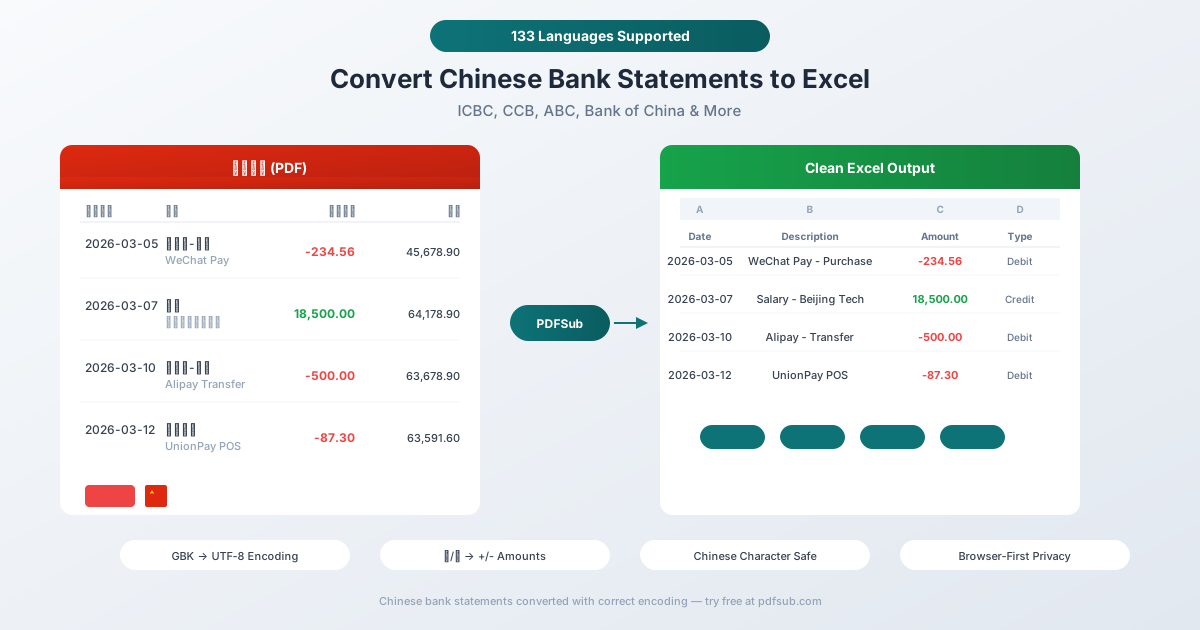
Why Chinese Bank Statements Break in Excel
Chinese bank statements present a unique combination of character encoding, language, and payment ecosystem challenges that go beyond simple number formatting.
1. GBK vs. UTF-8 Encoding (乱码)
This is the most immediate problem for anyone processing Chinese financial data outside China.
Chinese banks typically export CSV files in GBK encoding - a character encoding standard specific to Simplified Chinese that predates UTF-8. When you open a GBK file on a system expecting UTF-8, every Chinese character becomes garbled. The Chinese term for this is 乱码 (luànmǎ), literally "messy code."
| What You Should See | What UTF-8 Displays |
|---|---|
| 工商银行 交易明细 | ¹¤ÉÌÒøÐÐ ½»Ò×Ã÷ϸ |
| 转账 张三 | תÕÊ ÕÅÈÝ |
| 支付宝 消费 | Ö§¸¶±¦ Ïû·Ñ |
Like Japanese Shift_JIS, GBK files have no Byte Order Mark (BOM) to identify the encoding. Auto-detection is unreliable, especially in files mixing Chinese characters with Latin text and numbers.
The encoding landscape is further complicated by China having multiple standards: GB2312 (1980, 6,763 characters), GBK (1995, 21,003 characters), and GB18030 (2000, 70,244 characters, mandatory for software in China). Banks may use any of these, and converting from one to another can produce errors if characters exist in GBK but not GB2312.
2. All-Chinese Column Headers and Descriptions
Chinese bank statements use Chinese characters for everything:
- 交易日期 (Transaction Date)
- 摘要 (Summary/Description)
- 交易金额 (Transaction Amount)
- 对方户名 (Counterparty Name)
- 余额 (Balance)
- 借/贷 (Debit/Credit)
For non-Chinese speakers, every field is opaque. Even with translation, Chinese banking terminology uses specific vocabulary: 摘要 (zhāiyào, "abstract") for the transaction type, 对方户名 (duìfāng hùmíng, "opposite party account name") for the counterparty. A converter needs to not only preserve the Chinese text but also map these fields to English equivalents.
3. WeChat Pay and Alipay Descriptors
China's mobile payment ecosystem creates a unique bank statement problem. When a payment is made through Alipay or WeChat Pay using a linked bank card, the bank statement shows:
- WeChat Pay: "财付通" (Cáifù Tōng / Tenpay) - the underlying payment processor
- Alipay: "支付宝" (Zhīfùbǎo) or the legal entity name
The actual merchant - whether it's a restaurant, supermarket, or online store - is not shown on the bank statement. You see a generic platform name instead. In a country where over 968 million people use mobile payments and Alipay plus WeChat Pay process over $80 trillion annually, this means a significant portion of your bank statement entries are opaque.
If the payment was made from the wallet balance (rather than a linked card), it doesn't appear on the bank statement at all - only in the payment app's own transaction history.
4. Separate Debit and Credit Indicators
Chinese bank statements use the accounting terms 借 (jiè, debit) and 贷 (dài, credit) as column indicators rather than positive/negative amounts. Some statements use a single amount column with a separate 借/贷 indicator column. Others use the combined approach of showing the sign in the amount.
The debit/credit convention in Chinese accounting follows the same logic as Western double-entry bookkeeping, but the Chinese characters need to be correctly interpreted by the converter.
5. Simplified vs. Traditional Chinese
Mainland Chinese bank statements use Simplified Chinese (简体中文) exclusively. However, statements from Hong Kong branches of Chinese banks (ICBC Asia, BOC Hong Kong) use Traditional Chinese (繁体中文). Approximately 2,000 characters were simplified, meaning a converter must handle both character sets:
| Simplified | Traditional | Meaning |
|---|---|---|
| 银行 | 銀行 | Bank |
| 余额 | 餘額 | Balance |
| 转账 | 轉賬 | Transfer |
6. Number Formatting (The Easy Part)
China uses the same number formatting as the US: commas for thousands, periods for decimals (¥1,234.56). This is one of the few things that transfers cleanly to English Excel. The yen/yuan symbol (¥) may need to be stripped for calculation, but the numbers themselves don't require reformatting.
The yen has no subunit in practice, but the yuan technically has two decimal places (角 jiǎo = 0.1 yuan, 分 fēn = 0.01 yuan), so amounts typically show two decimal places: ¥1,234.56.
7. Date Formatting (Also Relatively Easy)
Chinese dates use YYYY-MM-DD or YYYY年MM月DD日 format - year first, which is ISO 8601 compliant. This is actually less ambiguous than European DD/MM/YYYY dates. However, the 年月日 characters need to be stripped for Excel to recognize the date. Some statements also include timestamps: "2026-03-15 14:23:45."
Major Chinese Banks and Their Statements
ICBC (中国工商银行)
The world's largest bank by total assets (~$6.3-7.3 trillion) with approximately 770 million personal customers and 552 million mobile banking users. Over 15,000 branches. Offers PDF statements and CSV export through online banking (工行e生活). CSV exports use GBK encoding.
China Construction Bank (中国建设银行)
Second-largest bank with approximately 757 million personal customers and 10.8 million corporate customers. Over 14,000 branches. PDF and CSV transaction history available through online banking.
Agricultural Bank of China (中国农业银行)
Third-largest with approximately 860 million retail customers - the largest customer base of any Chinese bank. Approximately 24,000 branches, the most extensive rural network. PDF statements available; CSV exports in GBK encoding.
Bank of China (中国银行)
Fourth of the Big Four with over 10,000 branches. Most internationally oriented of the state banks. Offers statements in both Chinese and English for some account types - valuable for expats. PDF and CSV downloads available.
Postal Savings Bank (中国邮政储蓄银行)
Approximately 600 million personal customers and over 40,000 branches (leveraging the China Post network). Reaches virtually every township in China. Popular with rural populations and migrant workers for domestic remittances.
China Merchants Bank (招商银行)
The "Retail King" of Chinese banking with 210 million retail customers. Approximately $1.6 trillion in total assets. Known for superior mobile banking and customer service. The preferred bank of China's urban middle class.
Digital Banks: MYbank and WeBank
MYbank (网商银行, Ant Group): 50+ million SME customers, no physical branches. Famous for its "310" model - 3-minute application, 1-second disbursement, 0 human intervention.
WeBank (微众银行, Tencent): 300+ million individual customers. China's first internet-only bank, established 2014. Statements entirely digital.
Method 1: Use PDFSub (Recommended)
PDFSub handles Chinese bank statements natively - including all the encoding and language challenges above.
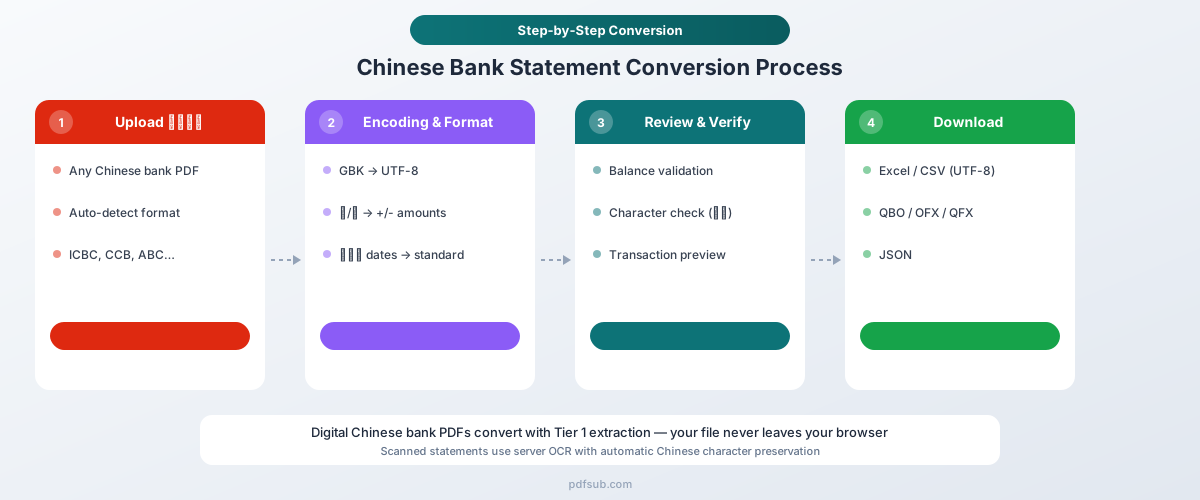
How It Works
-
Upload your 交易明细 - Drag and drop the PDF from any Chinese bank. PDFSub auto-detects the bank format from the 20,000+ supported templates.
-
Automatic format handling - The converter automatically:
- Detects and converts GBK/GB18030 encoding to UTF-8
- Preserves Simplified and Traditional Chinese characters correctly
- Maps Chinese column headers (交易日期, 摘要, 交易金额) to English equivalents
- Identifies Alipay (支付宝) and WeChat Pay (财付通) transaction entries
- Parses 借/贷 (debit/credit) indicators into signed amounts
- Strips 年月日 characters from dates and converts to standard format
- Handles both Big Four state bank and commercial bank layouts
-
Review and verify - Check the extracted transactions in the preview. Balances are validated against the statement's opening and closing 余额.
-
Download - Export as Excel (.xlsx), CSV (UTF-8), QBO (QuickBooks), OFX (Xero, Wave), QFX (Quicken), or JSON.
Why PDFSub Works for Chinese Statements
130+ languages including Chinese. The extraction engine understands Chinese banking terminology - 转账, 汇款, 存款, 取款, 手续费, 支付宝, 财付通 - and maps them to structured fields.
Encoding handled automatically. No need to manually detect or convert between GBK, GB18030, and UTF-8. PDFSub identifies the encoding and normalizes everything to UTF-8 with proper handling of Simplified and Traditional Chinese characters.
Every major Chinese bank supported. From ICBC's 770 million customers to CCB, ABC, Bank of China, Postal Savings Bank, China Merchants Bank, and dozens of regional and commercial banks.
Browser-first privacy. For digital PDFs from online banking, text extraction happens entirely in your browser. The file never leaves your device. Server-side processing is only used for scanned documents.
Platform-aware parsing. Alipay and WeChat Pay transactions are correctly identified and labeled, even though bank statements only show platform names (支付宝, 财付通) rather than merchant names.
Method 2: Your Bank's CSV Export
Most major Chinese banks offer CSV transaction downloads through online banking. Here's what to expect:
What You'll Get
- Encoding: Almost always GBK (not UTF-8)
- Delimiter: Standard comma (,)
- Date format: YYYY-MM-DD or YYYY/MM/DD
- Columns: Typically 交易日期, 摘要, 交易金额, 借/贷, 余额, 对方户名, 对方账号, 备注
Limitations
GBK encoding. Opening the CSV on any non-Chinese system produces garbled text. You need to explicitly set the encoding when importing: In Excel, use Data → Get Data → From Text/CSV → Select "Chinese Simplified (GB2312)" or "Chinese GBK" encoding.
Platform names only. WeChat Pay and Alipay transactions show the platform name, not the merchant. You'll need the payment app's own transaction history for merchant details.
Limited history. Most banks offer CSV export for 12-18 months. Official stamped statements (银行流水) from the branch counter may cover longer periods.
No standardized format. Each Chinese bank uses its own column order, naming, and structure. ICBC's export format differs from CCB's, which differs from ABC's.
Method 3: Manual Copy-Paste (Not Recommended)
The problems are severe with Chinese statements:
- Chinese characters may not paste correctly between applications
- Encoding conversion fails silently - characters that look correct may be wrong Unicode codepoints
- Column headers in Chinese require manual translation and mapping
- 借/贷 indicators need manual conversion to positive/negative amounts
- 年月日 date characters need manual stripping
- WeChat Pay and Alipay entries require manual categorization
- No validation against opening/closing balances
For any volume of transactions, this approach is impractical.
Chinese Financial Systems You Should Know
Golden Tax System (金税系统)
China's nationwide VAT monitoring system, currently in Phase IV. Uses an online network to control VAT invoices and has expanded to cross-agency data sharing with banking, customs, and social security systems. Phase IV significantly increases scrutiny of bank transactions for tax compliance.
Fapiao (发票) Invoice System
China's official tax invoice system, administered by the State Taxation Administration. Two categories:
- General VAT fapiao (普通发票) - for any registered company, no VAT deduction
- Special VAT fapiao (增值税专用发票) - allows VAT input credit claims
Electronic fapiao (e-fapiao) is replacing paper versions nationwide. Bank statement data is a critical cross-reference for fapiao reconciliation - matching payments to invoices.
VAT Rates in China
| Rate | Applies To |
|---|---|
| 13% | Most goods, processing, repair, tangible property leasing |
| 9% | Transportation, postal, basic telecom, real estate, agriculture, books |
| 6% | Modern services (financial, consulting, IT) |
| 1% | Small-scale taxpayers (simplified levy) |
Chinese Accounting Software
| Software | Target | Market Position |
|---|---|---|
| Yonyou (用友) | Medium to large enterprises | #1 Chinese ERP market |
| Kingdee (金蝶) | Small to medium businesses | #1 in China's EPM market |
| SAP | Large/multinational enterprises | 33% of large Chinese companies |
| Oracle | Large enterprises | 20% of large Chinese companies |
Both Yonyou and Kingdee support CSV bank statement import. PDFSub's Excel and CSV exports can be imported directly.
CIPS (Cross-Border Interbank Payment System)
China's RMB clearing system, processing 8.2 million transactions totaling RMB 175.49 trillion ($24.47 trillion) in 2024. Cross-border transactions on bank statements may show CIPS identifiers alongside SWIFT codes.
Who Needs Chinese Bank Statement Conversion?
CPAs and accounting firms. China has over 360,000 CPA members and 10,665 accounting firms serving 4.2+ million enterprises. They process client bank statements for bookkeeping, VAT reconciliation, and Golden Tax System compliance.
Foreign residents. An estimated 4.7 million foreigners live in China, concentrated in Shanghai, Beijing, Guangdong, and Yunnan. Most bank statements are entirely in Chinese with no English option (Bank of China is a notable exception for some accounts). Foreigners need converted statements for home-country tax filing and visa documentation.
US citizens filing FBAR. Americans in China with aggregate foreign account balances exceeding $10,000 at any point during the year must file FBAR (FinCEN Form 114). Civil penalties reach up to $16,536 per violation. Chinese bank statements need to be in a format American accountants can process.
International businesses. Companies with Chinese subsidiaries need to consolidate Chinese banking data with global accounting systems. The Big Four state banks collectively dominate corporate banking, and their statement formats require encoding conversion and field mapping for integration.
Cross-border traders. China is the world's largest exporter. Businesses buying from or selling to Chinese suppliers need to reconcile payments against Chinese bank statements, particularly for CIPS and SWIFT cross-border transactions.
Students abroad. Chinese students studying overseas need bank statements for visa applications, proof of funds, and financial documentation. These statements need to be translated and properly formatted for foreign institutions.
Tips for Working with Chinese Financial Data in Excel
Check for 乱码 first. If any Chinese text appears as garbled characters (¹¤ÉÌ, ½»Ò×, etc.), the file was opened with the wrong encoding. Re-import using GBK encoding or use PDFSub's UTF-8 Excel export to avoid the issue entirely.
Map platform names to categories. Create a lookup for common platform descriptors: 财付通 = WeChat Pay, 支付宝 = Alipay, 银联 = UnionPay. This helps categorize the many mobile payment transactions on modern Chinese statements.
Understand 借/贷. 借 (jiè) means debit (money out), 贷 (dài) means credit (money in). If your statement uses a single amount column with a separate indicator, create a formula to convert: =IF(indicator="借", -amount, amount).
Cross-reference with payment apps. Since bank statements only show platform names for mobile payments, export transaction history from Alipay and WeChat Pay separately for complete merchant-level detail.
Keep the original PDF. Chinese tax law requires retention of financial records. The 银行流水 (bank transaction flow) is an important document for tax audits and compliance. Always keep the original PDF alongside your converted Excel file.
Watch for capital control documentation. Cross-border transfers exceeding the individual annual limit of $50,000 may have additional documentation requirements reflected in statement annotations.
Frequently Asked Questions
Can I convert ICBC (工商银行) statements to Excel?
Yes. ICBC is the world's largest bank with approximately 770 million personal customers. PDFSub handles ICBC PDF statements natively, converting the Chinese formatting - including GBK encoding, Chinese column headers, and 借/贷 indicators - to clean, UTF-8 encoded spreadsheet data with English field names.
How do I fix garbled Chinese characters (乱码)?
乱码 occurs when a GBK-encoded file is opened as UTF-8 (or vice versa). PDFSub avoids this entirely by detecting the encoding automatically and exporting in UTF-8. If you're working with raw CSV files, specify "Chinese Simplified (GB2312)" or "Chinese GBK" encoding when importing into Excel.
Can PDFSub handle WeChat Pay and Alipay entries?
PDFSub correctly identifies 财付通 (Tenpay/WeChat Pay) and 支付宝 (Alipay) transactions on bank statements. However, the bank statement itself only shows the platform name, not the individual merchant. For merchant-level detail, you'll need to export transaction history from the payment apps separately.
Do Chinese digital bank statements have OCR issues?
Statements downloaded from online banking are native digital PDFs with selectable text - extraction is fast and accurate. OCR is needed for scanned paper statements or the official stamped 银行流水 obtained from branch counters (which are often printed on thermal paper that fades). PDFSub handles both digital PDFs and scanned documents.
Can I export Chinese bank data into Yonyou or Kingdee?
PDFSub exports to Excel, CSV (UTF-8), QBO, OFX, QFX, and JSON. For Chinese accounting software (Yonyou, Kingdee), export to CSV and import using the software's bank statement import feature. The properly encoded data from PDFSub ensures clean import without 乱码.
Does PDFSub handle both Simplified and Traditional Chinese?
Yes. PDFSub supports both Simplified Chinese (used in mainland China) and Traditional Chinese (used in Hong Kong, Macau, and Taiwan). Statements from mainland Chinese banks use Simplified characters, while Hong Kong branches of Chinese banks (ICBC Asia, BOC Hong Kong) may use Traditional characters.
How many Chinese banks does PDFSub support?
PDFSub supports 20,000+ bank formats globally, including all major Chinese banks: the Big Four (ICBC, CCB, ABC, Bank of China), Postal Savings Bank, Bank of Communications, China Merchants Bank, CITIC, Minsheng Bank, and dozens of regional and commercial banks.
Can I convert multiple Chinese statements at once?
Yes. Upload multiple 交易明细 (transaction statements) and PDFSub processes them sequentially. Each statement is auto-detected and converted independently, even if they're from different banks with different layouts and encoding conventions.
Try PDFSub Free - full access to the Bank Statement Converter and 98+ other PDF tools on the All-In-One plan ($20/user/mo annual). Cancel anytime.