PDF Tools for Teachers: Merge, Compress, and Share Course Materials
Teachers create and distribute more PDFs than almost any other profession - worksheets, syllabi, handouts, presentations, and reports. Here's how to merge, compress, convert, and share course materials without fighting your LMS or blowing your budget.
You probably didn't go into teaching because you love wrestling with file formats. But here you are, Sunday night, trying to upload a 47-page course packet to Canvas and hitting a file size wall. Or emailing a syllabus to 150 students and watching it bounce back because the attachment is too large. Or spending 20 minutes merging six worksheets into one handout because your school doesn't have an Adobe Acrobat license.
Teachers create and distribute more PDFs than almost any other profession. Worksheets. Syllabi. Lesson plans. Handouts. Slide decks converted for student access. Report cards. Permission slips. Recommendation letters. IEP documents. Assessment rubrics. The list doesn't stop.
And yet, the tools available to handle all those documents are often expensive, confusing, or locked behind institutional IT departments that move at glacial speed. The average teacher already spends $895 out of pocket each year on classroom supplies - a number that has increased 49% since 2015 - and spending money on PDF software rarely feels like a priority when you need markers, notebooks, and snacks for kids who came to school hungry.
This guide maps every common PDF task in a teacher's workflow to practical solutions. Whether you're a K-12 teacher managing 30 students, a college professor coordinating multiple sections, or an instructional designer building online courses, there's a workflow here that will save you time.
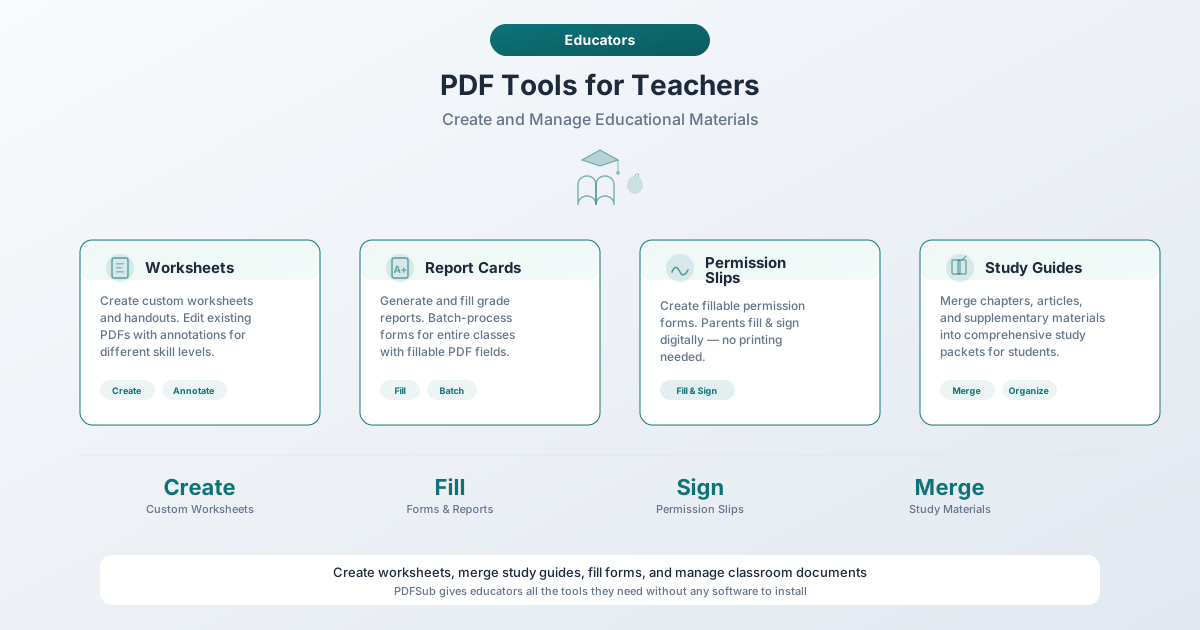
The Hidden PDF Problem in Education
Think about your last week of teaching. How many of these did you do?
- Printed worksheets from a PDF
- Emailed a document to students or parents
- Uploaded files to your learning management system
- Converted a PowerPoint to PDF so students could view it on any device
- Signed a permission slip, evaluation form, or administrative document
- Scanned a page from a textbook or workbook
- Combined multiple files into a single handout
If you checked more than two, you're spending meaningful hours each week on PDF management - time that could go toward lesson planning, grading, or the rare luxury of not working.
Most schools provide Google Workspace or Microsoft 365, which handle document creation well but fall short when you need to merge PDFs, compress large files, fill forms, or make scanned pages searchable. The gap drives many educators to cobble together workflows from random free websites - uploading sensitive student documents to unknown servers in the process.
There's a better way. Let's walk through the six PDF tasks teachers do most, with practical solutions for each.
1. Merge: Combine Handouts into Student Packets
The Problem
Monday's lesson requires a reading passage, a vocabulary worksheet, a graphic organizer, and a homework assignment. Each exists as a separate file. You could print them individually - four trips to the copier, four chances for the stapler to jam - or you could combine them into a single PDF that students access digitally or you print as one packet.
Course packets are one of the most common teacher PDF tasks, and they come in several flavors:
- Weekly packets - combining that week's readings, worksheets, and assignments
- Unit materials - all resources for a multi-week unit in one document
- Semester syllabi - merging the syllabus, course schedule, grading policies, academic integrity statement, and accommodation information into one comprehensive document
- Exam review packets - compiling study guides, practice problems, and key concept summaries from across multiple units
- Sub plans - assembling everything a substitute teacher needs into one organized file
The Solution
PDFSub's Merge PDFs tool lets you drag and drop multiple PDF files, reorder them however you want, and combine them into a single document. Everything happens in your browser - your files stay on your device.
A practical workflow for weekly packets:
- Save each worksheet, reading, and assignment as a separate PDF
- Open the Merge tool and drop all files in
- Drag to reorder - put the instructions first, then readings, then the worksheet
- Merge and download the combined PDF
- Upload the single file to your LMS or print double-sided
This is especially useful at the start of a semester. Instead of uploading 8 separate policy documents to your course page, merge the syllabus, schedule, grading rubric, late work policy, academic integrity statement, office hours, technology requirements, and accessibility statement into one "Course Information" PDF. Students get one file to download and reference all semester.
Time Savings
Merging 5-8 documents manually (opening each, printing to PDF, rearranging) typically takes 10-15 minutes. A dedicated merge tool does it in under 60 seconds.
2. Compress: Shrink Files for LMS Uploads and Email
The Problem
Every learning management system has file size limits, and teachers hit them constantly. Here are the practical constraints you're working within:
| Platform | Upload Limit | Notes |
|---|---|---|
| Canvas | 500 MB per file | Institutional quotas may be lower; student video submissions often capped at 500 MB |
| Blackboard | 500 MB default | Administrators can configure lower limits; many institutions set 100-250 MB |
| Google Classroom | Drive storage dependent | No per-file limit, but school Google Workspace accounts have pooled storage caps |
| Moodle | 16 MB default | Can be configured up to 1 GB, but many schools leave the default in place |
| Email attachments | 10-25 MB | Gmail caps at 25 MB; Outlook at 20 MB; many school email systems at 10 MB |
The most common offenders are scanned documents - a flatbed scan of 10 pages at 300 DPI can easily produce a 40-50 MB PDF. PowerPoint presentations with embedded images often exceed 20 MB. And merged packets add up fast. Moodle's 16 MB default catches teachers off guard more than any other limit.
The Solution
PDFSub's Compress PDF tool reduces file size while keeping the document readable. You can choose the compression level based on your needs - light compression for documents that need to stay crisp, or heavy compression for files that just need to be small enough to upload.
When to compress:
- Before uploading scanned materials to any LMS
- Before emailing documents to parents or students
- After merging multiple files into a large packet
- When sharing via Google Drive and storage is tight
- Before attaching files to assignment submissions in Google Classroom
Practical tip: Compress after merging. If you combine six worksheets into a 35 MB packet, run it through compression to bring it down to 5-8 MB before uploading to your LMS. Most text-based PDFs compress dramatically - a 35 MB scan-heavy document can often drop to under 5 MB with minimal quality loss.
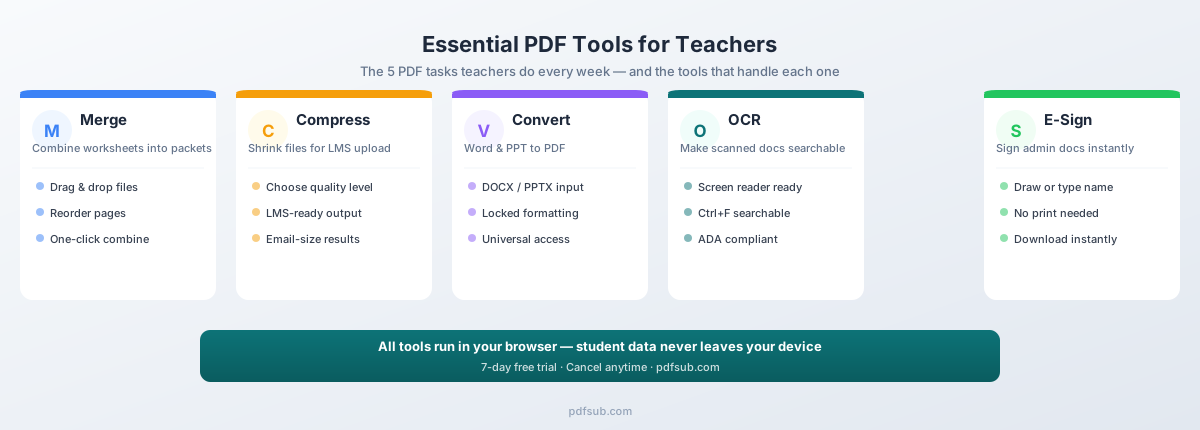
3. Convert: Turn Presentations and Documents into Universal PDFs
The Problem
You created a lesson in PowerPoint. Or a worksheet in Word. Now you need students to view it without messing up the formatting - no shifted images, no broken tables, no "I can't open this file" emails from parents. PDF is the universal read-only format: formatting stays intact, students can't accidentally edit, and it works on Chromebooks, iPads, phones, and the ancient desktop in the computer lab.
The Solution
- Word to PDF - PDFSub's Word to PDF converter handles DOC and DOCX files, preserving tables, images, and formatting
- PowerPoint to PDF - The PowerPoint to PDF converter turns slide decks into flat PDFs that students can view and print without needing PowerPoint
- PDF to Word - When you need to edit a PDF worksheet, modify a colleague's handout, or update last year's syllabus - PDFSub's PDF to Word converter creates an editable DOCX file
The best workflow: Build materials in Word or PowerPoint (easy to edit), convert to PDF for distribution (locked formatting), upload to your LMS, and keep the original for future editing.
4. Fill Forms: Create and Complete Digital Worksheets
The Problem
The pandemic accelerated a shift that was already underway: students completing work digitally. But most teacher-created worksheets are flat PDFs - students can view them but can't type answers into them. The workaround? Students print the PDF, write answers by hand, take a photo with their phone, and upload the photo. The result is a blurry, sideways image that's painful to grade.
Fillable PDF forms solve this. Students open the PDF, type directly into designated fields, and submit a clean, legible document. No printing, no photos, no squinting at handwriting.
Beyond student worksheets, teachers encounter fillable forms in their administrative work constantly:
- District evaluation forms
- Professional development logs
- Budget request forms
- Field trip permission slips
- Student accommodation plans
- Grant applications
The Solution
PDFSub's PDF Form Filler detects interactive form fields in existing PDFs and lets you fill them directly in your browser. Professional development logs, evaluation paperwork, budget requests, permission slips, recommendation templates, HR forms - complete and save them without printing a single page.
Tip for creating fillable worksheets: Design worksheets in Word or Google Docs with form fields (text input boxes) where you want student answers. When converted to PDF, these fields become interactive - students click and type directly into the document.
5. E-Sign: Sign Administrative Documents Without Printing
The Problem
Teachers sign a staggering number of documents each year. Recommendation letters for students applying to college. Administrative evaluations. Professional development certificates. Parent communication logs. Field trip approvals. Contract renewals. IEP documents.
The traditional workflow: receive a PDF by email, print it, sign it with a pen, scan it back to PDF, email it back. Four steps and a trip to the copier for what should take 10 seconds.
The Solution
PDFSub's E-Sign PDF tool lets you add your signature to any PDF directly in your browser. Draw your signature with a mouse or trackpad, type it, or upload an image of your signature. Place it on the document, adjust the size, and download the signed PDF.
This covers recommendation letters (especially during fall rush when you might have 20-30 to sign), administrative evaluations, professional development documentation, parent communication forms, and employment contracts.
Time savings during recommendation season: A teacher writing 25 recommendation letters saves over an hour by signing digitally instead of printing, signing, scanning, and re-uploading each one.
6. OCR: Make Scanned Materials Searchable and Accessible
The Problem
Every teacher has done it: photocopied a page from a textbook, a chapter from a supplementary resource, or a worksheet from a colleague. The result is a scanned PDF - it looks like text, but it's actually an image. You can't search it, select text from it, or have a screen reader read it aloud.
This matters for two reasons. First, it's inconvenient - students can't use Ctrl+F to find a term, can't copy a quote for their essay, and can't resize the text on a small screen. Second, and more importantly, it's an accessibility problem.
The Solution
PDFSub's OCR - Extract Text tool converts scanned PDFs into searchable, selectable text. The original visual layout is preserved, but a text layer is added underneath that makes the content machine-readable.
When teachers need OCR:
- Scanned textbook pages - Make them searchable so students can find specific passages
- Photocopied worksheets - Convert image-based copies into text that screen readers can process
- Historical documents - Make primary source materials accessible for student research
- Handwritten notes - PDFSub's Handwritten Conversion tool can convert handwritten notes into editable digital text
- Archived materials - Digitize file cabinets of old worksheets and lesson plans into searchable documents
Accessibility: Why It Matters and What the Law Requires
This section isn't optional reading. If you work at a public school or any institution that receives federal funding, accessibility is a legal requirement - and the enforcement landscape is getting stricter.
The Legal Framework
Section 508 of the Rehabilitation Act and Title II of the ADA require that digital materials at federally funded institutions - including public schools - be accessible to people with disabilities. The Department of Education's Office for Civil Rights has actively investigated districts (including Seattle Public Schools and Arlington Public Schools in Virginia) for inaccessible digital documents.
The compliance deadline is real: K-12 schools in counties with 50,000+ residents must meet updated digital accessibility standards by April 24, 2026. Smaller districts have until April 24, 2027.
What Accessible PDFs Require
Meeting WCAG 2.1 Level AA standards means your PDFs need searchable text (not image-based scans), logical reading order, alternative text on images, sufficient color contrast, proper heading hierarchy (H1, H2, H3 - not just bold text), identified table headers, and language identification in document properties.
Three Practical Steps
You don't need to become an accessibility expert overnight. These three actions address the most common issues:
-
Run OCR on everything scanned. Scanned documents are images, not text - screen readers can't process them. PDFSub's OCR tool and Make Searchable tool fix this in one step.
-
Use heading styles, not bold text. The built-in Heading 1, 2, 3 styles in Word or Google Docs create structural hierarchy that screen readers navigate. Bold text that looks like a heading provides zero structural information.
-
Add alt text to images. Before converting to PDF, right-click images and add descriptions. A chart is meaningless to a screen reader unless you describe what it shows.
LMS Upload Best Practices
Every LMS has its quirks. Here are the essentials for the four most common platforms.
- Canvas - Allows up to 500 MB per file, but institutional storage quotas may be lower. Canvas has a built-in accessibility checker for rich content, but it doesn't scan uploaded PDFs - make them accessible before uploading. Create modules for each week so students see materials in order.
- Blackboard - Default limit is 500 MB, but many institutions configure 100-250 MB caps. Supports batch uploads, so you can upload a week's worth of materials in one session. Use descriptive content area names.
- Google Classroom - No per-file limit, but all uploads go to Google Drive where school accounts have pooled storage. For PDF worksheets, use "Students can view file" (the "Make a copy" option only works with Google Docs).
- Moodle - Default upload limit is just 16 MB, the lowest of any major LMS. Many schools leave this default in place. If you're uploading scanned materials, you'll almost certainly need to compress first.
Cross-Platform Tips
- Name files descriptively.
ENG101_Week3_ReadingPacket.pdfbeatsscan2026030201.pdf. - Compress before uploading. Faster than troubleshooting upload failures.
- Test the student view. Every LMS has a student preview - use it to verify files open correctly.
- Keep originals. Maintain uncompressed versions locally for future editing.
Building Course Material Packets
Here are three packet templates that cover most of the semester. Each one starts with a merge step and ends with a compress step.
Semester Welcome Packet - Merge the syllabus, course calendar, grading rubric, late work policy, academic integrity statement, technology requirements, accommodation statement, and contact information into one PDF. Students lose individual documents. A single BIO201_Spring2026_CourseInfo.pdf is easier to find and reference all semester.
Weekly Learning Packet - Merge the week's overview, required readings, discussion questions, worksheet, and homework assignment. Compress after merging - aim for under 10 MB so students on mobile data can download without issues.
Exam Review Compilation - Merge the study guide, vocabulary sheet, practice problems from each unit, answer key (released at your discretion), and exam logistics. These compilations save students from hunting through weeks of LMS uploads.
Organizing Your Educational PDFs
A disorganized file system wastes time every semester. Two habits fix this.
Use a consistent naming convention: [Course]_[Type]_[Topic]_[Week].pdf
ENG101_Worksheet_CharacterAnalysis_W03.pdfBIO201_Reading_CellDivision_W07.pdfMATH150_Exam_Midterm_F2026.pdf
The course prefix makes it instantly clear where a file belongs. The type tells you what it is. The topic helps you find it. The week number places it in context.
Organize by semester, then by course, then by week. Create a top-level folder for each academic year, subfolders for each course, and weekly folders within those. Keep a separate Templates folder for reusable materials that carry forward. At the end of each semester, merge all student handouts into a single "Complete Materials" PDF per course as a reference for next time, then archive the semester folder. This takes 30 minutes and saves hours of hunting for "that worksheet I used last spring."
The Budget Reality
Let's address the elephant in the room. Teachers are underfunded, and the data is clear:
- The average teacher spends $895 per year out of pocket on classroom supplies
- 97% of teachers say their school-provided budget is insufficient
- The median school supply budget provided by schools is just $200
- 20% of teachers work a second job - a 25% increase since 2023
Spending $20/month on Adobe Acrobat isn't realistic when you're already buying markers and granola bars for your students. That's why affordable and free options matter so much in education.
PDFSub offers a 7-day free trial so you can test every tool before committing. The core PDF tools that teachers use most - merge, compress, convert, and fill forms - are available without needing enterprise pricing. And because most processing happens directly in your browser, you're not paying for server time on basic operations.
Even for teachers buying tools out of pocket, the cost pays for itself the first week you stop fighting with file sizes and format conversions.
Frequently Asked Questions
Can I batch-convert a folder of Word documents to PDF?
Yes. PDFSub's Batch Convert tool lets you convert multiple files at once. If you have 15 worksheets in Word format that need to become PDFs for your LMS, you can convert them all in one step instead of opening each file individually.
How do I create fillable quizzes that students can complete digitally?
Create your quiz in Word or Google Docs using form fields (text input boxes) for each answer, then convert to PDF. The form fields carry over as interactive fields that students can type into. For multiple-choice quizzes, use your LMS's built-in quiz builder instead - Canvas, Blackboard, Google Forms, and Moodle all have auto-grading quiz features.
My scanned textbook pages are huge. How do I reduce the file size?
Scanned pages are large because they're stored as images. Two steps will dramatically reduce the size:
- Run OCR first - PDFSub's OCR tool converts the image-based text into actual text, which is inherently smaller than pixel data.
- Then compress - The Compress PDF tool reduces image quality to a level that's still perfectly readable but much smaller. A 50 MB scan of 10 textbook pages can typically be compressed to 3-5 MB.
How do I share large files when email won't work?
For files that exceed email attachment limits (10-25 MB depending on your provider):
- Upload to your LMS and share the link - this is the most reliable method for students
- Upload to Google Drive or OneDrive and share a view-only link
- Compress the PDF first - many files that exceed email limits can be compressed below the threshold
Can I convert PDFs into formats students can edit?
Yes. PDFSub's PDF to Word converter creates editable DOCX files. This is useful when you want students to modify a template - fill in a graphic organizer, annotate a passage, or complete a structured writing assignment. Convert the PDF to Word, share the DOCX, and students can edit directly.
How do I make a PDF accessible for students with visual impairments?
Three steps: (1) Run OCR on scanned documents so screen readers can process the text, (2) use proper heading styles (H1, H2, H3) in your source documents so the reading order is logical, and (3) add alt text to images before converting to PDF. Check if your school's disability services office has additional guidelines.
I teach multiple sections of the same course. How do I manage materials efficiently?
Create a master folder for the course, not the section. Copy the master file and modify only section-specific details (exam dates, due dates). Use naming conventions to distinguish: ENG101_S01_Syllabus_Spring2026.pdf vs. ENG101_S02_Syllabus_Spring2026.pdf.
Your Workflow, Simplified
Teaching is complex enough without PDF headaches. Here's the workflow that covers 90% of what teachers need:
- Create materials in Word, Google Docs, or PowerPoint - whatever you're comfortable with
- Convert to PDF for distribution - locked formatting, universal access
- Merge related materials into packets - one file per week or unit
- Compress before uploading - fits any LMS limit, downloads fast on any connection
- OCR anything scanned - accessibility and searchability in one step
- Sign administrative documents - no more print-sign-scan loops
PDFSub handles all six steps, and you can try every tool free for 7 days at pdfsub.com. Your files stay in your browser for most operations, which means you're not uploading student materials or sensitive administrative documents to unknown servers.
You became a teacher to educate, not to troubleshoot file formats. The right tools let you get back to the work that actually matters.